Stokes stream function

In fluid dynamics, the Stokes stream function is used to describe the streamlines and flow velocity in a three-dimensional incompressible flow with axisymmetry. A surface with a constant value of the Stokes stream function encloses a streamtube, everywhere tangential to the flow velocity vectors. Further, the volume flux within this streamtube is constant, and all the streamlines of the flow are located on this surface. The velocity field associated with the Stokes stream function is solenoidal—it has zero divergence. This stream function is named in honor of George Gabriel Stokes.
Cylindrical coordinates

Consider a cylindrical coordinate system ( ρ , φ , z ), with the z–axis the line around which the incompressible flow is axisymmetrical, φ the azimuthal angle and ρ the distance to the z–axis. Then the flow velocity components uρ and uz can be expressed in terms of the Stokes stream function by:[1]

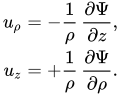
The azimuthal velocity component uφ does not depend on the stream function. Due to the axisymmetry, all three velocity components ( uρ , uφ , uz ) only depend on ρ and z and not on the azimuth φ.
The volume flux, through the surface bounded by a constant value ψ of the Stokes stream function, is equal to 2π ψ.
Spherical coordinates

In spherical coordinates ( r , θ , φ ), r is the radial distance from the origin, θ is the zenith angle and φ is the azimuthal angle. In axisymmetric flow, with θ = 0 the rotational symmetry axis, the quantities describing the flow are again independent of the azimuth φ. The flow velocity components ur and uθ are related to the Stokes stream function through:[2]
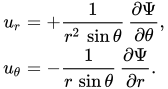
Again, the azimuthal velocity component uφ is not a function of the Stokes stream function ψ. The volume flux through a stream tube, bounded by a surface of constant ψ, equals 2π ψ, as before.
Vorticity
The vorticity is defined as:
- , where


with the unit vector in the –direction.


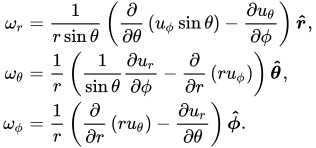
Derivation of vorticity using a Stokes stream function Consider the vorticity as defined by From the definition of the curl in spherical coordinates:
First notice that the and components are equal to 0. Secondly substitute and into The result is:
Next the following algebra is performed:




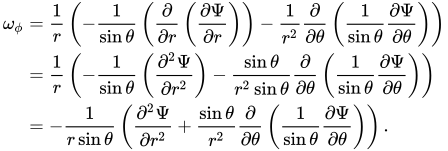
As a result, from the calculation the vorticity vector is found to be equal to:
![{\displaystyle {\boldsymbol {\omega }}={\begin{pmatrix}0\\[1ex]0\\[1ex]\displaystyle -{\frac {1}{r\sin \theta }}\left({\frac {\partial ^{2}\Psi }{\partial r^{2}}}+{\frac {\sin \theta }{r^{2}}}{\partial \over \partial \theta }\left({\frac {1}{\sin \theta }}{\frac {\partial \Psi }{\partial \theta }}\right)\right)\end{pmatrix}}.}](https://wikimedia.org/api/rest_v1/media/math/render/svg/6f9fb7b9db57674b0172810e4c521b5c9207b649)
Comparison with cylindrical
The cylindrical and spherical coordinate systems are related through
- and


Alternative definition with opposite sign
As explained in the general stream function article, definitions using an opposite sign convention – for the relationship between the Stokes stream function and flow velocity – are also in use.[3]
Zero divergence
In cylindrical coordinates, the divergence of the velocity field u becomes:[4]
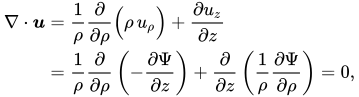
as expected for an incompressible flow.
And in spherical coordinates:[5]
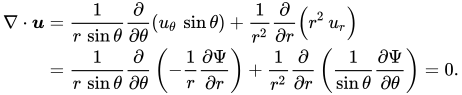
Streamlines as curves of constant stream function
From calculus it is known that the gradient vector is normal to the curve (see e.g. Level set#Level sets versus the gradient). If it is shown that everywhere using the formula for in terms of then this proves that level curves of are streamlines.


- Cylindrical coordinates
In cylindrical coordinates,
- .
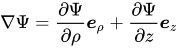
and

So that

- Spherical coordinates
And in spherical coordinates
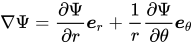
and

So that

Notes
- ^ Batchelor (1967), p. 78.
- ^ Batchelor (1967), p. 79.
- ^ E.g. Brenner, Howard (1961). "The slow motion of a sphere through a viscous fluid towards a plane surface". Chemical Engineering Science. 16 (3–4): 242–251. Bibcode:1961ChEnS..16..242B. doi:10.1016/0009-2509(61)80035-3.
- ^ Batchelor (1967), p. 602.
- ^ Batchelor (1967), p. 601.
References
- Batchelor, G.K. (1967). An Introduction to Fluid Dynamics. Cambridge University Press. ISBN 0-521-66396-2.
- Lamb, H. (1994). Hydrodynamics (6th ed.). Cambridge University Press. ISBN 978-0-521-45868-9. Originally published in 1879, the 6th extended edition appeared first in 1932.
- Stokes, G.G. (1842). "On the steady motion of incompressible fluids". Transactions of the Cambridge Philosophical Society. 7: 439–453. Bibcode:1848TCaPS...7..439S.
Reprinted in: Stokes, G.G. (1880). Mathematical and Physical Papers, Volume I. Cambridge University Press. pp. 1–16.
Content Disclaimer
Informasi ini disarikan dari Wikipedia dan disajikan kembali untuk tujuan edukasi. Konten tersedia di bawah lisensi CC BY-SA 3.0. Kami tidak bertanggung jawab atas ketidakakuratan data yang bersumber dari kontribusi publik tersebut.
- The information displayed on this website is sourced in part or in whole from Wikipedia and has been adapted for the purpose of restating it. We strive to provide accurate and relevant information, however:
- There is no guarantee of absolute accuracy. Wikipedia is an open, collaborative project that can be edited by anyone, so information is subject to change.
- It is not intended to constitute professional advice. The content displayed is for informational and educational purposes only. For important decisions (e.g., medical, legal, or financial), please consult a professional.
- Content copyright. Wikipedia is licensed under the Creative Commons Attribution-ShareAlike License (CC BY-SA). This means that content may be reused with appropriate attribution and shared under a similar license.
- Responsible use. Any risk arising from the use of information from this website is entirely the responsibility of the user.