Talk:Edge connectivity
 | This article is rated Start-class on Wikipedia's content assessment scale. It is of interest to the following WikiProjects: | ||||||||||
| |||||||||||

This should NOT redirect from "k-connected graph". The two are very distinct concepts, and the latter NEEDS an entry...
- You're right. Fixed. —David Eppstein 16:49, 22 October 2006 (UTC)
This seems to be redundant, given the Connectivity (graph theory) article. Radagast3 (talk) 00:18, 1 May 2008 (UTC)
- There is plenty of material to expand this and K-vertex-connected graph into two separate long articles. —David Eppstein (talk) 00:20, 1 May 2008 (UTC)
- Agreed, but I'm too busy to do it. ;) Radagast3 (talk) 00:36, 1 May 2008 (UTC)
 | This article has previously been nominated to be moved. Please review prior discussions if you are considering renomination.
Discussions
|
Complexity
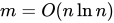
Gabow's paper states complexity, not . Reminiscenza (talk) 11:40, 2 June 2015 (UTC)


- There's no contradiction between those two bounds. k is necessarily O(n) and m is necessarily O(n2). So if you eliminate those two variables and express everything in terms of n, you get O(n3).—David Eppstein (talk) 15:20, 2 June 2015 (UTC)
- Yes, but why we need to express everything in terms of n? For graph algorithms, complexity is usually expressed in terms of m and n, and whatever other parameters available - so that the bound is useful for both sparse and dense graphs. Bound is at least misleading for sparse graphs, where it is possible that , and overall complexity would be , much better than . — Preceding unsigned comment added by Reminiscenza (talk • contribs) 06:21, 3 June 2015 (UTC)


Proper math
- In graph theory, a graph with edge set is said to be -edge-connected if is connected for all with .
- Is it syntactically correct to say , as G is a graph (= a set of vertices and a set of edges connecting some vertices) whereas X is a set of edges? --Abdull (talk) 15:33, 27 July 2008 (UTC)


Stronger
- If a graph is -edge-connected then , where is the minimum degree of any vertex .
- Can we make this theorem stronger by saying , as we could delete all but one edges from a vertex and still have all vertices of this connected graph connected? --Abdull (talk) 15:55, 27 July 2008 (UTC)


Consistency
It is usual, even on this WIKI, to write a graph as an ordered pair (V,E) with vertex set V and edge set E. This article does it the other way around. Is there a compelling reason for this? Leen Droogendijk (talk) 11:31, 28 June 2012 (UTC)
Contradiction between the formal definition and the next section
Consider a graph G of a single vertex and no edge. According to the formal definition, G is k-edge-connected for all k. On the other hand, the minimum vertex degree of G is 0, thus the statement of the second section does not hold for this example. --Jalpar75 —Preceding undated comment added 15:59, 9 August 2013 (UTC)
Move discussion in progress
There is a move discussion in progress on Talk:K-vertex-connected graph which affects this page. Please participate on that page and not in this talk page section. Thank you. —RMCD bot 17:04, 24 July 2025 (UTC)
Move discussion in progress
There is a move discussion in progress on Talk:K-vertex-connected graph which affects this page. Please participate on that page and not in this talk page section. Thank you. —RMCD bot 11:49, 20 September 2025 (UTC)
Content Disclaimer
Informasi ini disarikan dari Wikipedia dan disajikan kembali untuk tujuan edukasi. Konten tersedia di bawah lisensi CC BY-SA 3.0. Kami tidak bertanggung jawab atas ketidakakuratan data yang bersumber dari kontribusi publik tersebut.
- The information displayed on this website is sourced in part or in whole from Wikipedia and has been adapted for the purpose of restating it. We strive to provide accurate and relevant information, however:
- There is no guarantee of absolute accuracy. Wikipedia is an open, collaborative project that can be edited by anyone, so information is subject to change.
- It is not intended to constitute professional advice. The content displayed is for informational and educational purposes only. For important decisions (e.g., medical, legal, or financial), please consult a professional.
- Content copyright. Wikipedia is licensed under the Creative Commons Attribution-ShareAlike License (CC BY-SA). This means that content may be reused with appropriate attribution and shared under a similar license.
- Responsible use. Any risk arising from the use of information from this website is entirely the responsibility of the user.