Talk:Legendre function
 | This article is rated Start-class on Wikipedia's content assessment scale. It is of interest to the following WikiProjects: | ||||||||||
| |||||||||||

Incorrect graph
The graph is not correct. For example the value for l=5, m=1, x=0 should be -15/8 but is around -0.32. — Preceding unsigned comment added by 129.16.35.40 (talk) 08:35, 30 April 2013 (UTC)
Stop the redirect
I do not understand why the redirect is here. I can not seem to find the information that fits here on any other wikipedia site. The page which it redirects to is about a special case of the Legendre function. Neltah 15:51, 11 May 2007 (UTC)
Analytic continuation
The definition for associated Legendre functions of the first and second kind are given for certain domains in . There needs to be a discussion of how these functions are extended to other values of in the complex plane. HowiAuckland (talk) 14:12, 17 December 2010 (UTC)

Possible mistake

is different equation 8.820.2 in Gradshteyn, I. S., and I. M. Ryzhik, 2000, Table of integrals, series, and products, sixth ed.: Academic Press. (translated from the Russian).
and from equation 14.3.7 in Dunster, T. M., 2010, "Legendre and Related Functions" in "NIST Handbook of Mathematical Functions", Cambridge University Press.
which both state:

instead.
It should also be noted, that for \mu = 0, we receive the Legendre Functions. — Preceding unsigned comment added by 130.238.140.30 (talk) 16:33, 19 February 2013 (UTC)
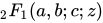
- The Gauss hypergeometric function does not change when the parameters and are interchanged. So these formulae are identical.HowiAuckland (talk) 19:34, 28 May 2013 (UTC)


Differential Equations Section requires an edit
The section contains the sentence:"Like all such equations, it can be converted into the hypergeometric differential equation by a change of variable, and its solutions can be expressed using hypergeometric functions." This is obscure. Is this sentence referring to the general Legendre equation or second order linear equations or 2nd order linear DIFFERENTIAL equations (I don't have any idea what a 2nd order linear equation is, do you?) or is it referring to 2nd order linear (differential) equations with (3 ) singular points. "all such" is enormously sloppy and ambiguous. Also, imho the claim that ALL similar equations can be converted to hypergeometric DiffEQs requires, imho, a reference. That's three things, in case you're counting. (and if you include removing the "the" in front of 'the hypergeometric differential equation' that makes four. (This last I will change, being the one thing I'm confident enough of my understanding).173.189.72.93 (talk) 20:01, 17 November 2014 (UTC)
Content Disclaimer
Informasi ini disarikan dari Wikipedia dan disajikan kembali untuk tujuan edukasi. Konten tersedia di bawah lisensi CC BY-SA 3.0. Kami tidak bertanggung jawab atas ketidakakuratan data yang bersumber dari kontribusi publik tersebut.
- The information displayed on this website is sourced in part or in whole from Wikipedia and has been adapted for the purpose of restating it. We strive to provide accurate and relevant information, however:
- There is no guarantee of absolute accuracy. Wikipedia is an open, collaborative project that can be edited by anyone, so information is subject to change.
- It is not intended to constitute professional advice. The content displayed is for informational and educational purposes only. For important decisions (e.g., medical, legal, or financial), please consult a professional.
- Content copyright. Wikipedia is licensed under the Creative Commons Attribution-ShareAlike License (CC BY-SA). This means that content may be reused with appropriate attribution and shared under a similar license.
- Responsible use. Any risk arising from the use of information from this website is entirely the responsibility of the user.