Talk:Proper transfer function
 | This article is rated Start-class on Wikipedia's content assessment scale. It is of interest to the following WikiProjects: | |||||||||||||
| ||||||||||||||


Is the current definition correct?
Is the current definition general enough? Currently it is only applicable to finite dimensional LTI systems. Would the high frequency result presented at the end of the article (which should probably be written as a limit) be a better definition? And then the current definition would be a result of the proposed definition when applied to FDLTI systems. Take for example a time lag. It has a unity amplitude frequency response, so it clearly fits the definition that I'm proposing, but it does not fit the definition currently in the article. Anyway, I'll search some texts to see if my suggestion is supported by the literature. If so, I'll post an edit unless someone objects. 128.250.5.248 (talk) 00:33, 14 August 2009 (UTC)
Frequency response approaches zero?
I question the statement:
A strictly proper transfer function will approach zero as the frequency approaches infinity.
which is true for all physical processes.
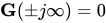
For example, a simple differentiator, such as a voltage-driven capacitor or a velocity-driven mass, has an improper transfer function and therefore an infinite frequency response at infinity.Roesser 14:37, 27 July 2007 (UTC) — Preceding unsigned comment added by 71.167.60.210 (talk)
I think that such systems could not be constructed in practice. Any mechanical system would require infinite energy to excite with an input of infinite frequency. 98.219.230.191 (talk) 15:25, 14 December 2012 (UTC)
A frequency of infinity corresponds to a time of zero. Having any value other than zero means that it has moved from its starting position at the starting time, which is a contradiction for any real system. A differentiator is not a real system. 124.188.176.245 (talk) 06:25, 27 June 2013 (UTC)
A voltage divider, or constant, is an example of a function that does not fall to zero at high frequency. Is a constant not realizable as a physical process? (170.223.207.14 (talk) 18:39, 23 January 2014 (UTC))
No, an ideal constant is not realizable since this implies in instant change, which requires infinite energy. In reality a constant actually has a low-pass filter. Using your example of a voltage divider, if you apply an oscilloscope with proper temporal resolution you'll see there is a rate of change in the voltage divider, this rate of change is a result of the electrons flowing through the system until the steady state of Ohm's Law is reached. For digital systems this is actually a design problem, see the wiki page on Propagation Delay. Dr.AnonymousCoward 186.222.49.244 (talk) 11:02, 25 February 2014 (UTC)
Content Disclaimer
Informasi ini disarikan dari Wikipedia dan disajikan kembali untuk tujuan edukasi. Konten tersedia di bawah lisensi CC BY-SA 3.0. Kami tidak bertanggung jawab atas ketidakakuratan data yang bersumber dari kontribusi publik tersebut.
- The information displayed on this website is sourced in part or in whole from Wikipedia and has been adapted for the purpose of restating it. We strive to provide accurate and relevant information, however:
- There is no guarantee of absolute accuracy. Wikipedia is an open, collaborative project that can be edited by anyone, so information is subject to change.
- It is not intended to constitute professional advice. The content displayed is for informational and educational purposes only. For important decisions (e.g., medical, legal, or financial), please consult a professional.
- Content copyright. Wikipedia is licensed under the Creative Commons Attribution-ShareAlike License (CC BY-SA). This means that content may be reused with appropriate attribution and shared under a similar license.
- Responsible use. Any risk arising from the use of information from this website is entirely the responsibility of the user.