Talk:Pure shear
 | This article is rated Stub-class on Wikipedia's content assessment scale. It is of interest to the following WikiProjects: | ||||||||||||||||||||
| |||||||||||||||||||||
.jpg)


Removed Content
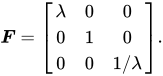
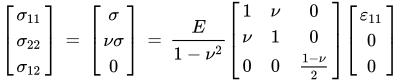
The following content was removed because it gives a misleading definition of pure shear. The definition is taken from an experimental paper where they get pure shear by constraining the upper and lower boundaries of a cube of material. Clearly, the following states cannot be pure shear in the general sense because the shear shows up in the off diagonal components of the deformation gradient, and the strain tensor. The linear elastic example given doesn't even include a shear strain component!
If is the stretch ratio applied to the material, then the deformation gradient in pure shear can be expressed as[1]

The linear elastic stress-strain law for the case of pure shear is:
Various definitions
The title of this article has various meanings in different sources. For instance, in 1998 Pavel Belik contributed "The State of Pure Shear" to the Journal of Elasticity (52(1):91-8), which states the following:
- In classical continuum mechanics a state of pure shear is defined as one for which there is some orthonormal basis relative to which the normal components of the Cauchy stress tensor vanish. An equivalent characterization is that the trace of the Cauchy stress tensor must vanish.doi:10.1023/A:1007500316569
The articles on shear mapping and shear matrix have precise content compared to the title of this article.— Rgdboer (talk) 03:00, 1 December 2018 (UTC)
- ^ Moreira, D.C.; Nunes, L.C.S. (April 2013). "Comparison of simple and pure shear for an incompressible isotropic hyperelastic material under large deformation". Polymer Testing. 32 (2): 240–248. doi:10.1016/j.polymertesting.2012.11.005.
Content Disclaimer
Informasi ini disarikan dari Wikipedia dan disajikan kembali untuk tujuan edukasi. Konten tersedia di bawah lisensi CC BY-SA 3.0. Kami tidak bertanggung jawab atas ketidakakuratan data yang bersumber dari kontribusi publik tersebut.
- The information displayed on this website is sourced in part or in whole from Wikipedia and has been adapted for the purpose of restating it. We strive to provide accurate and relevant information, however:
- There is no guarantee of absolute accuracy. Wikipedia is an open, collaborative project that can be edited by anyone, so information is subject to change.
- It is not intended to constitute professional advice. The content displayed is for informational and educational purposes only. For important decisions (e.g., medical, legal, or financial), please consult a professional.
- Content copyright. Wikipedia is licensed under the Creative Commons Attribution-ShareAlike License (CC BY-SA). This means that content may be reused with appropriate attribution and shared under a similar license.
- Responsible use. Any risk arising from the use of information from this website is entirely the responsibility of the user.