Talk:Reed–Muller code
| This is the talk page for discussing improvements to the Reed–Muller code article. This is not a forum for general discussion of the subject of the article. |
Article policies
|
| Find sources: Google (books · news · scholar · free images · WP refs) · FENS · JSTOR · TWL |
 | This article is rated C-class on Wikipedia's content assessment scale. It is of interest to the following WikiProjects: | ||||||||||
| |||||||||||

Construction
I think: should read:


otherwise you have a mismatch in the number of dimensions 131.111.243.37 (talk) 23:11, 21 November 2008 (UTC)
Not true. Have made the construction in the article a bit clearer. The things in the curly braces are points, not the values of coordinates. Trogsworth (talk) 23:29, 24 November 2008 (UTC)
The confusion arises because the contents in the item bounded by the curly braces may be considered a vector or a set. In this case, it is intended to be a set.Norm16wiki (talk) 15:51, 30 May 2016 (UTC)
still wrong notation
The confusion between d and r is not fixed--still wrong in the first paragraph, at least if you're going to use the notation RM(d,r), where r is the order. The length should be d=2^n e.g. With these changes in the first paragraph, the rest of the page seems OK.
Steve —Preceding unsigned comment added by 67.233.119.183 (talk) 13:13, 25 December 2008 (UTC)
I went through the article and attempted to clear up all of the inconsistency and confusion around the use of the d, r, n, m notation. I adopted the conventional RM(r,m) notation. I attempted to use Forney's notation of RM(r,n), where the code length is N=2^n, but I changed n to m for consistency with other contributors.Norm16wiki (talk) 21:27, 30 May 2016 (UTC) [1][2] — Preceding unsigned comment added by Norm16wiki (talk • contribs) 21:25, 30 May 2016 (UTC)
References
Notations
I think that it would be better to use the more common notation RM(r,m) instead of RM(d,r). The current notation leads to a confsion with the code distance. Moreover, RM(r,m) is more common in the literature (like in one of the most known books: S. Lin and D. J. Costello - Error Control Coding).
Templates: CCSDS is pretty obscure; where is "Error Correction Coding"?
It's amusing that the only template is the "Consultative Committee for Space Data Systems", which is useful for only a rather exclusive group. I'd love an "Error Correction Coding" template. Sanpitch (talk) 15:42, 24 August 2013 (UTC)
Not suited to much of its audience
This article is suited neither to the intoxicated nor to the ill educated. Let's have it somewhat simpler, please. Or work a dancing monkey into it somehow so that everyone gets something from it. 86.170.7.13 (talk) 21:06, 3 April 2016 (UTC)
- Well, looks like there's consensus here. Image added. 86.170.7.13 (talk) 21:42, 3 April 2016 (UTC)
- Agreed. 81.98.14.109 (talk) 23:19, 12 April 2016 (UTC)
I guess I am another representative of the ill educated (BS in math/physics not withstanding, insult not required). This is a member of a family of articles which are rendered opaque by the use of a specific notation which is, itself, not readily searchable. For starters, it would have helped me follow if it had started out defining the hollow F super N sub 2 as 'the set of all N digit numbers of base 2". I'm still puzzling over the (hollow I sub A)sub i. I suppose this notation is used in some series of math courses or textbooks that I haven't read. I'd be happy to learn it but for that I need a link. — Preceding unsigned comment added by 2620:149:5:2102:8137:BD41:7D01:1FCA (talk) 21:27, 9 December 2016 (UTC)
Properties
I attempted to improve the clarity of the proof of Property 1. The notation used earlier had scalars being added to vectors, and had checks of equality between scalars and vectors. I found that confusing, and I think I have captured what the earlier contribution intended. Norm16wiki (talk) 21:35, 30 May 2016 (UTC)
Mistake in the "example" section of "construction using low-degree polynomials"
I may be misinterpreting the meaning of this example, however it appears that some of the evaluations of the polynomial at each evaluation point are incorrect?
My evaluation of them yields that C(1 1010 010101) = 1101 1110 0001 0010, which agrees with the encoding given by my implementation of the code, based on a generator matrix. The generator matrix I use also agrees (albeit with the columns in reverse order) with the generator matrix for RM(2,4) given in this paper.
I'd like to go ahead and correct this, but I would just like to make absolutely sure that I am not misinterpreting the methodology of the example. — Preceding unsigned comment added by Arcayn (talk • contribs) 16:41, 24 May 2020 (UTC)
Typos in the proof?
1. Unless I am missing something, in the proof of linear independence of the row vectors of the generator matrix the "case " and "case " in the following definition should be exchanged


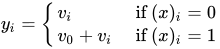
That is, I suspect that it was meant to be written as follows:
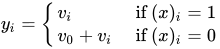
2. Then a few lines later
"By 1 and has weight 1 = 20 = 2m−r "

was probably meant to be By 1 and has weight 1 = 20 = 2m−m

Proposal to add an "Applications" section to balance coding theory algebra
Hi all. I've just updated the lead section to mention the use of Reed-Muller codes in post-quantum cryptography. Looking over the article as a whole, it is heavily skewed toward formal mathematical definitions, constructions, and decoding algorithms, but currently lacks a dedicated "Applications" section (unlike e.g. the Reed–Solomon article). I think creating such section could help ground the abstract algebra with practical use cases and make article more suitable for broader audience.
I'd be happy to help draft/organize such a section if there are no objections. Axialis (talk) 14:55, 2 August 2026 (UTC)
Content Disclaimer
Informasi ini disarikan dari Wikipedia dan disajikan kembali untuk tujuan edukasi. Konten tersedia di bawah lisensi CC BY-SA 3.0. Kami tidak bertanggung jawab atas ketidakakuratan data yang bersumber dari kontribusi publik tersebut.
- The information displayed on this website is sourced in part or in whole from Wikipedia and has been adapted for the purpose of restating it. We strive to provide accurate and relevant information, however:
- There is no guarantee of absolute accuracy. Wikipedia is an open, collaborative project that can be edited by anyone, so information is subject to change.
- It is not intended to constitute professional advice. The content displayed is for informational and educational purposes only. For important decisions (e.g., medical, legal, or financial), please consult a professional.
- Content copyright. Wikipedia is licensed under the Creative Commons Attribution-ShareAlike License (CC BY-SA). This means that content may be reused with appropriate attribution and shared under a similar license.
- Responsible use. Any risk arising from the use of information from this website is entirely the responsibility of the user.