Talk:Riesz function
 | This article is rated Start-class on Wikipedia's content assessment scale. It is of interest to the following WikiProjects: | ||||||||||
| |||||||||||

Maclaurin series
"The Maclaurin series coefficients of F increase in absolute value until they reach their maximum at the 40th term of -1.753 x 10¹⁷. By the 109th term they have dropped below one in absolute value." For what value of z? (In the former case, I calculate z must be (about) 38.8; and the latter, the value is certainly not the same ...)
- What value of z <it>are</it> we talking about here?
- It is also worth noting that:
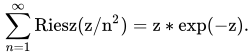
- See Riesz's original paper ...
Notation and language in original Riesz paper
Reading the original paper by Riesz, it is necessary to beware of his non-standard usage, especially in respect of variable in the Mellin transform - which is idiosyncratic, and not in conformity with modern usage! Hair Commodore (talk) 12:24, 3 June 2008 (UTC)
Aside of that, Riesz's French is itself, to say the least, idiosyncratic! Reading it is hard work, indeed. Hair Commodore (talk) 13:50, 25 June 2008 (UTC) Indeed, a careful reading of the paper shows thAt it was almost certainly put together from two drafts,written in slightly different notations. Hair Commodore (talk) 12:56, 17 April 2009 (UTC)
Since writing the above, I have acquired a copy of Riesz's ''Collected Papers. I find that his German is also - to say the least - odd.Hair Commodore (talk) 17:11, 27 June 2008 (UTC)
There is one other apparent oddity in the paper: an apparntly "hidden" refernce to a monograph by Ernst Leonard Lindelöf - when Riesz refers to «D'après le ealcul des résidus» in a context where it makes little sense. The monograph by Lindelöf is the only thing I can think of to explain it! Hair Commodore (talk) 14:33, 27 May 2009 (UTC)
- Riesz's word «or» is a kind of "rather", a bit like «d'ailleurs» - to put it another way. 81.102.15.200 (talk) 11:17, 19 June 2009 (UTC) (and I hope that this is both accurate and helpful!)
Recent paper by Wilf
THere's a much more recent contribution to the function at [1]. Perhaps, this should be included in the main article? It is quite interesting, from several points of view. Hair Commodore (talk) 12:00, 7 May 2009 (UTC)
I may as well add that it's possible to read the original paper online at [2] Hair Commodore (talk) 12:46, 26 May 2009 (UTC)
A generalization of the Riesz functio: "Riesz-Hardy-Littlewood wave"
- In [3] Stefano Beltraminelli and Danilo Merlini introduced a generalization of the Riesz function. (They call the pehnomenon they describe the "Riesz-Hardy-Littlewood wave".)They show by calculation that for a range of parameters many examples of their generalization (including the original Riesz function) oscillate for large positive real argument. (Just as might be expected of functions dedfined as these are.) I hope that this is of interest insofaras it connects directly with the Riemann Hypothesis! Hair Commodore (talk) 12:14, 25 September 2009 (UTC)
This is article does not seem trustworthy
The article has only three references. Three of them (one of them from Riesz himself!) don't refer to "the Riesz function" but rather to "Riesz's function" or "a function considered by Riesz". There is no "Riesz function" at Mathworld.
"Riesz function" must be an invention in this article. It cannot be right to find a random function in some paper, say by Gauss, and just create an article "Gauss function" on wikipedia.
Also, I didn't see the notation "Riesz(x)" anywhere except this article. The original paper uses "F(x)". "Riesz(x)" is another invention in the article.
Plus, what is "Riemann Hypthesis".
Finally, how is it that for large x, A(x) = B? Shouldn't there be big-O notation or something? Doubledork (talk) 00:28, 27 November 2012 (UTC)
Content Disclaimer
Informasi ini disarikan dari Wikipedia dan disajikan kembali untuk tujuan edukasi. Konten tersedia di bawah lisensi CC BY-SA 3.0. Kami tidak bertanggung jawab atas ketidakakuratan data yang bersumber dari kontribusi publik tersebut.
- The information displayed on this website is sourced in part or in whole from Wikipedia and has been adapted for the purpose of restating it. We strive to provide accurate and relevant information, however:
- There is no guarantee of absolute accuracy. Wikipedia is an open, collaborative project that can be edited by anyone, so information is subject to change.
- It is not intended to constitute professional advice. The content displayed is for informational and educational purposes only. For important decisions (e.g., medical, legal, or financial), please consult a professional.
- Content copyright. Wikipedia is licensed under the Creative Commons Attribution-ShareAlike License (CC BY-SA). This means that content may be reused with appropriate attribution and shared under a similar license.
- Responsible use. Any risk arising from the use of information from this website is entirely the responsibility of the user.