Taylor microscale
In fluid dynamics, the Taylor microscale, which is sometimes called the turbulence length scale, is a length scale used to characterize a turbulent fluid flow.[1] This microscale is named after Geoffrey Ingram Taylor. The Taylor microscale is the intermediate length scale at which fluid viscosity significantly affects the dynamics of turbulent eddies in the flow. This length scale is traditionally applied to turbulent flow which can be characterized by a Kolmogorov spectrum of velocity fluctuations. In such a flow, length scales which are larger than the Taylor microscale are not strongly affected by viscosity. These larger length scales in the flow are generally referred to as the inertial range. Below the Taylor microscale the turbulent motions are subject to strong viscous forces and kinetic energy is dissipated into heat. These shorter length scale motions are generally termed the dissipation range.
Calculation of the Taylor microscale is not entirely straightforward, requiring formation of certain flow correlation function(s),[2] then expanding in a Taylor series and using the first non-zero term to characterize an osculating parabola. The Taylor microscale is proportional to , while the Kolmogorov microscale is proportional to , where is the integral scale Reynolds number. A turbulence Reynolds number calculated based on the Taylor microscale is given by


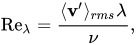
where is the root mean square of the velocity fluctuations. The Taylor microscale is given as

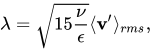
where is the kinematic viscosity, and is the rate of energy dissipation. A relation with turbulence kinetic energy can be derived as


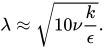
The Taylor microscale gives a convenient estimation for the fluctuating strain rate field
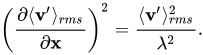
Other relations
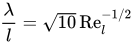
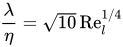
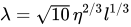
The Taylor microscale falls in between the large-scale eddies and the small-scale eddies, which can be seen by calculating the ratios between and the Kolmogorov microscale . Given the length scale of the larger eddies , and the turbulence Reynolds number referred to these eddies, the following relations can be obtained:[3]



Notes
- ^ Tennekes & Lumley (1972) pp. 65–68.
- ^ Landahl, M.T. & E. Mollo-Christensen. Turbulence and Random Processes in Fluid Mechanics. Cambridge, 2ed, 1992.
- ^ Pope, Stephen (2000). Turbulent Flows (1st ed.). Cambridge. p. 200. ISBN 9780521598866.
References
- Tennekes, H.; Lumley, J.L. (1972), A First Course in Turbulence, Cambridge, MA: MIT Press, ISBN 978-0-262-20019-6
Content Disclaimer
Informasi ini disarikan dari Wikipedia dan disajikan kembali untuk tujuan edukasi. Konten tersedia di bawah lisensi CC BY-SA 3.0. Kami tidak bertanggung jawab atas ketidakakuratan data yang bersumber dari kontribusi publik tersebut.
- The information displayed on this website is sourced in part or in whole from Wikipedia and has been adapted for the purpose of restating it. We strive to provide accurate and relevant information, however:
- There is no guarantee of absolute accuracy. Wikipedia is an open, collaborative project that can be edited by anyone, so information is subject to change.
- It is not intended to constitute professional advice. The content displayed is for informational and educational purposes only. For important decisions (e.g., medical, legal, or financial), please consult a professional.
- Content copyright. Wikipedia is licensed under the Creative Commons Attribution-ShareAlike License (CC BY-SA). This means that content may be reused with appropriate attribution and shared under a similar license.
- Responsible use. Any risk arising from the use of information from this website is entirely the responsibility of the user.