Triangle wave
| Triangle wave | |
|---|---|
 A bandlimited triangle wave[1] pictured in the time domain (top) and frequency domain (bottom). The fundamental is at 220 Hz (A3). | |
| General information | |
| General definition | |
| Fields of application | Electronics, synthesizers |
| Domain, codomain and image | |
| Domain | |
| Codomain | |
| Basic features | |
| Parity | Odd |
| Period | 1 |
| Specific features | |
| Root | |
| Derivative | Square wave |
| Fourier series | |


![{\displaystyle \left[-1,1\right]}](https://wikimedia.org/api/rest_v1/media/math/render/svg/79566f857ac1fcd0ef0f62226298a4ed15b796ad)



A triangular wave or triangle wave is a non-sinusoidal waveform named for its triangular shape. It is a periodic, piecewise linear, continuous real function.
Like a square wave, the triangle wave contains only odd harmonics. However, the higher harmonics roll off much faster than in a square wave (proportional to the inverse square of the harmonic number as opposed to just the inverse).
Definitions

Definition
A triangle wave of period p that spans the range [0, 1] is defined as where is the floor function. This can be seen to be the absolute value of a shifted sawtooth wave.
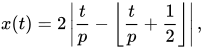

For a triangle wave spanning the range [−1, 1] the expression becomes


A more general equation for a triangle wave with amplitude and period using the modulo operation and absolute value is



For example, for a triangle wave with amplitude 5 and period 4:

A phase shift can be obtained by altering the value of the term, and the vertical offset can be adjusted by altering the value of the term.


As this only uses the modulo operation and absolute value, it can be used to simply implement a triangle wave on hardware electronics.
Note that in many programming languages, the % operator is a remainder operator (with result the same sign as the dividend), not a modulo operator; the modulo operation can be obtained by using ((x % p) + p) % p in place of x % p. In e.g. JavaScript, this results in an equation of the form 4*a/p * Math.abs((((x - p/4) % p) + p) % p - p/2) - a.
Relation to the square wave
The triangle wave can also be expressed as the integral of the square wave:

Expression in trigonometric functions
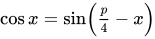
A triangle wave with period p and amplitude a can be expressed in terms of sine and arcsine (whose value ranges from −π/2 to π/2): The identity can be used to convert from a triangle "sine" wave to a triangular "cosine" wave. This phase-shifted triangle wave can also be expressed with cosine and arccosine:


Expressed as alternating linear functions
Another definition of the triangle wave, with range from −1 to 1 and period p, is

Harmonics

It is possible to approximate a triangle wave with additive synthesis by summing odd harmonics of the fundamental while multiplying every odd harmonic by −1 (or, equivalently, changing its phase by π) and dividing the amplitude of the harmonics by the square of their mode number, n (which is equivalent to their relative frequency to the fundamental).
The above can be summarised mathematically as follows: where N is the number of harmonics to include in the approximation, t is the independent variable (e.g. time for sound waves), is the fundamental frequency, and i is the harmonic label which is related to its mode number by .


This infinite Fourier series converges quickly to the triangle wave as N tends to infinity, as shown in the animation.
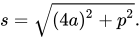
Arc length
The arc length per period for a triangle wave, denoted by s, is given in terms of the amplitude a and period length p by
See also
- List of periodic functions
- Sine wave
- Square wave
- Sawtooth wave
- Pulse wave
- Sound
- Triangle function
- Wave
- Zigzag
References
- ^ Kraft, Sebastian; Zölzer, Udo (5 September 2017). "LP-BLIT: Bandlimited Impulse Train Synthesis of Lowpass-filtered Waveforms". Proceedings of the 20th International Conference on Digital Audio Effects (DAFx-17). 20th International Conference on Digital Audio Effects (DAFx-17). Edinburgh. pp. 255–259.
Content Disclaimer
Informasi ini disarikan dari Wikipedia dan disajikan kembali untuk tujuan edukasi. Konten tersedia di bawah lisensi CC BY-SA 3.0. Kami tidak bertanggung jawab atas ketidakakuratan data yang bersumber dari kontribusi publik tersebut.
- The information displayed on this website is sourced in part or in whole from Wikipedia and has been adapted for the purpose of restating it. We strive to provide accurate and relevant information, however:
- There is no guarantee of absolute accuracy. Wikipedia is an open, collaborative project that can be edited by anyone, so information is subject to change.
- It is not intended to constitute professional advice. The content displayed is for informational and educational purposes only. For important decisions (e.g., medical, legal, or financial), please consult a professional.
- Content copyright. Wikipedia is licensed under the Creative Commons Attribution-ShareAlike License (CC BY-SA). This means that content may be reused with appropriate attribution and shared under a similar license.
- Responsible use. Any risk arising from the use of information from this website is entirely the responsibility of the user.