Uncomputation

Uncomputation is a technique, used in reversible circuits, for cleaning up temporary effects on ancilla bits so that they can be re-used.[1]
Uncomputation is a fundamental step in quantum computing algorithms. Whether or not intermediate effects have been uncomputed affects how states interfere with each other when measuring results.[2]
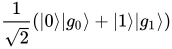
The process is primarily motivated by the principle of implicit measurement,[3][page needed] which states that discarding a register during computation is physically equivalent to measuring it. Failure to uncompute garbage registers can have unintentional consequences. For example, if we take the state where and are garbage registers. Then, if we do not apply any further operations to those registers, according to the principle of implicit measurement, the entangled state has been measured, resulting in a collapse to either or with probability . What makes this undesirable is that wave-function collapse occurs before the program terminates, and thus may not yield the expected result.



References
- ^ Aaronson, Scott; Grier, Daniel; Schaeffer, Luke (2015). "The Classification of Reversible Bit Operations". arXiv:1504.05155 [quant-ph].
- ^ Aaronson, Scott (2002). "Quantum Lower Bound for Recursive Fourier Sampling". Quantum Information and Computation. 3 (2): 165–174. arXiv:quant-ph/0209060. Bibcode:2002quant.ph..9060A. doi:10.26421/QIC3.2-7.
- ^ Nielsen, Michael A.; Chuang, Isaac L. (2010). Quantum computation and quantum information (10th Anniversary ed.). Cambridge: Cambridge University Press. ISBN 978-1107002173.
 | This quantum mechanics–related article is a stub. You can help Wikipedia by adding missing information. |
Content Disclaimer
Informasi ini disarikan dari Wikipedia dan disajikan kembali untuk tujuan edukasi. Konten tersedia di bawah lisensi CC BY-SA 3.0. Kami tidak bertanggung jawab atas ketidakakuratan data yang bersumber dari kontribusi publik tersebut.
- The information displayed on this website is sourced in part or in whole from Wikipedia and has been adapted for the purpose of restating it. We strive to provide accurate and relevant information, however:
- There is no guarantee of absolute accuracy. Wikipedia is an open, collaborative project that can be edited by anyone, so information is subject to change.
- It is not intended to constitute professional advice. The content displayed is for informational and educational purposes only. For important decisions (e.g., medical, legal, or financial), please consult a professional.
- Content copyright. Wikipedia is licensed under the Creative Commons Attribution-ShareAlike License (CC BY-SA). This means that content may be reused with appropriate attribution and shared under a similar license.
- Responsible use. Any risk arising from the use of information from this website is entirely the responsibility of the user.