User:EditingPencil/sandbox/node theorem
Existence criteria
The existence of a bound state is guaranteed if any of the existence criteria are met.
By variational Method
By variational method of finding ground state, if there exists a trial wavefunction whose energy expectation value is negative, there exists ground state solution which is bounded.[1]
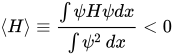
Bound states of Attractive potential
It can be shown that attractive potentials with negative spacial integral have at least one bound states in the dimensions .[2] Since this means that the potential has to go to zero to give a non-divergent integral, the potential is offset by it's values at infinity and the condition expressed as:

![{\displaystyle \int _{-\infty }^{\infty }\left[V(x)-V(\pm \infty )\right]\,dx<0}](https://wikimedia.org/api/rest_v1/media/math/render/svg/b4fa52af892c757dfe9540fb61d2a7631bc92874)
Node theorem
Node theorem states that n-th bound wavefunction ordered according to increasing energy has exactly n-1 nodes, ie. points where . Rigorous derivation of the condition is treated in analysis of second order homogenous differential equations.


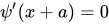
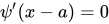
Due to the form of Schrodinger's time independent equations, it is not possible for a physical wavefunction to have since it corresponds to solution by the uniqueness of second order ordinary differential solutions. Considering a rigid wall around a point with , if the walls expand to infinity, , the eigenfunctions of the trapped system morphs into eigenfunctions of the Hamiltonian. If the new nodes are formed during this, then at some value of and point within the walls, either the nodes begin to form at the middle with or at the boundaries with or . Since wavefunction always remains zero at rigid walls, condition ensures that nodes are not formed and that the sign of these derivatives remain the same. At the instant the node begins to form at , it will be a local minima and hence have which is not possible.[3]





| Proof |
|---|
|
Accumulation of nodes is not possible for non trivial wavefunction. If there exists a limit point of nodes, then, the value of for the limit point but this corresponds to trivial solution having initial values . From Schrodinger's equations:
Multiplying with and subtracting equations of and
If , cannot be entirely positive or entirely negative in the region and must therefore have node within the consecutive nodes of . Note that this is independent on assuming sign of in this region. Thus wavefunctions with different energy levels always have different number of nodes or conversely wavefunctions with same number of nodes cannot have different energies. Thus in a 1D bound system where degeneracy is not allowed, all energy eigenfunctions differ by the number of nodes and when arranged in increasing order of energies, give increasing number of node. |












As a corollary, the no-node theorem states that the ground state of bound particles do not have any nodes.
References
Methods of Mathematical Physics Vol. I - Courant and Hilbert pp 451-455
https://arxiv.org/pdf/quant-ph/0702260.pdf
See Also
Sturm–Picone comparison theorem
- ^ "Criterion for existence of a bound state in one dimension". pubs.aip.org. doi:10.1119/1.19389. Retrieved 2023-12-14.
- ^ "titel".
- ^ Moriconi, M. (2007-03-01). "Nodes of wavefunctions". American Journal of Physics. 75 (3): 284–285. doi:10.1119/1.2404960. ISSN 0002-9505.
Content Disclaimer
Informasi ini disarikan dari Wikipedia dan disajikan kembali untuk tujuan edukasi. Konten tersedia di bawah lisensi CC BY-SA 3.0. Kami tidak bertanggung jawab atas ketidakakuratan data yang bersumber dari kontribusi publik tersebut.
- The information displayed on this website is sourced in part or in whole from Wikipedia and has been adapted for the purpose of restating it. We strive to provide accurate and relevant information, however:
- There is no guarantee of absolute accuracy. Wikipedia is an open, collaborative project that can be edited by anyone, so information is subject to change.
- It is not intended to constitute professional advice. The content displayed is for informational and educational purposes only. For important decisions (e.g., medical, legal, or financial), please consult a professional.
- Content copyright. Wikipedia is licensed under the Creative Commons Attribution-ShareAlike License (CC BY-SA). This means that content may be reused with appropriate attribution and shared under a similar license.
- Responsible use. Any risk arising from the use of information from this website is entirely the responsibility of the user.