Commutative Algebra
- Rings and hypersurfaces. Consider a ring
 and an ideal
 ![{\displaystyle I\subseteq R[t_{1},\cdots ,t_{n}]}](https://wikimedia.org/api/rest_v1/media/math/render/svg/12534e5dfd2e71d0b582a2657f7296c97c48a845) , then we define the following set (set
, then we define the following set (set  , the
, the  -affine space)
 which we call (affine) varieties. Finally, let
 ![{\displaystyle {\mathcal {O}}_{I}=R[t_{1},\cdots ,t_{n}]/I}](https://wikimedia.org/api/rest_v1/media/math/render/svg/470e5e4c28188e938589e3feebea03a8f4135f76) the space of functionals on
the space of functionals on  .
.
- Spectrum of a ring. Given a ring , we define the prime spectrum of a ring
 We also define the maximal spectrum as the space
  as the collection of all maximal ideals. Given a morphism
  and an ideal
  , the ideal
  is also prime, so
  induces a morphism
  In particular, the projection
  onto the quotient by an ideal
  , induces a map
  , whose image is the set of prime ideals containing . Also, given multiplicative set
  , the inclusion
  induces a map
  (where
  is the localization of to ). The image of
  are those ideals that are disjoint from .
- Radical and nilpotent elements. A nilpotent element
 is one such that
  for some . Let
  If
If  , the set
  is a multiplicative set, so using the result about prime ideals in , we can conclude that
  is the intersection of all prime ideals in .
- Local rings. A ring is a local ring if has a unique maximal ideal
 . Let
. Let  be the residue field. It's easy to prove that every non-unit element
  belongs to a maximal ideal (consider
  and the Prime Ideal Theorem), therefore is the ideal of all non-unit elements and every
  is a unit, with
  .
.
Noetherian Rings
- Ascending chain condition. Given a ring , a -module
 is Noetherian if every family of submodules has a maximal element. Consider now a submodule
  in a Noetherian module, then the family
  has a maximal element
  , which must be equal to
  , therefore in a Noetherian module every submodule is finitely generated. On the other hand, a module where every submodule is finitely generated, is Noetherian.
Tensor product
- Exactness of Hom. Consider an exact sequence of modules
 and, for a general module , the induced sequence
  first, it's immediate that since
  is onto, then
  is 1-1, so the first short sequence is exact. Then,
  , so
, so  . On the other hand, consider
  , which means that
  , so we have the following sequence of maps
 (where the first map is the inverse of the canonical isomorphism
  ), all the previous compositions define a morphism
  such that
  , thus
  and the sequence of Hom modules is exact. On the other hand, suppose that the Hom sequence is exact for all , then take
  , it's easy to see that
  (where
  is the canonical projection
  ), thus by exactness of the Hom sequence (in particular, is 1-1), we conclude that
  and is onto. Now, since is onto, we have an isomorphism
  such that
  (where
  is the canonical projection), then
  so
so  . On the other hand, if is instead the canonical projection
  , then
  so the original sequence is exact if and only if the Hom sequence is exact for every .
- Exactness of Tensor product. By definition,
 , so given a exact sequence then for every pair
  of modules, the induced Hom sequence is exact
 therefore the isomorphic sequence
  is exact for every
  , which implies (for the previous result), that the sequence
  is exact for every module . In particular, consider the exact sequence
  for an ideal , and a -module , then it's easy to prove that
  , so we have the following exact sequence
  which means
  (since
  is the inclusion
  ).
).
Localization
- Multiplicative set. Consider a ring , a subset is multiplicative if
 and
and  . Thus a multiplicative set is simply a submonoid of .
- Localization. Consider a ring and a multiplicative set , then let be the the quotient of
 modulo the equivalence
  let
let  be the equivalence class of the pair
  , then we define the following operations
  and also define the map as
  . Also, notice that
  maps to zero those elements that are zero divisors of elements in (that is,
  , then
  for some
  ). Notice that if is an integral domain, then
  is a multiplicative set and
  the field of fractions of . In case
  is the complement of some prime ideal
  , we denote by
  .
.
- Properties of localization. Given a prime ideal
 consider the localization and the ideal
  this ideal is maximal (since every ideal properly greater than
  contains an element
  , with
  , which is a unit with inverse
  ) and the unique maximal ideal of , thus
  is a local ring.
- Local property. A property of a ring is local if "true for the ring
 " is equivalent to "true for
  , for every prime ideal ".
Chain conditions and special elements
- Noetherian/Artinian ring. A ring is Noetherian if there is no strictly ascending infinite chain of ideals
 The ring is called Artinian if there is no strictly descending infinite chain of ideals.
- Finite algebras and finite type. Given a ring , an algebra over said ring is defined as
![{\displaystyle {\begin{cases}A{\text{ finite iff there is an onto }}R^{n}\longrightarrow A\\A{\text{ finite type iff there is an onto }}R[t_{1},\cdots ,t_{n}]\longrightarrow A\end{cases}}}](https://wikimedia.org/api/rest_v1/media/math/render/svg/99a4715833c134c9a262a35f07d0f97d35286170) clearly
clearly  is of finite type, thus every finite algebra is of finite type. Consider a Noetherian ring and an algebra of finite type, with a subalgebra
  such that is finite as a -algebra.
- Prime/Irreducible elements. An element
 in a ring is prime if
  is a prime ideal (which means that if
  ). An element is irreducible if
  (where
  is the group of units in ) and
  implies that either
  or
or  .
.
Integral ring extensions
- Integral extension. A ring extension
 is an integral extension if every element
  is the zero of a monic polynomial, that is, in the form
![{\displaystyle f=x^{n+1}+a_{n}x^{n}+\cdots +a_{0}\in R[x]}](https://wikimedia.org/api/rest_v1/media/math/render/svg/362fdeddc469a1b4ac9caa09df4855230470ccc5)
- Noether normalization theorem. Given a field
 and a -algebra that is of finite type (that is, it is a finitely generated -algebra), then there are elements
  such that the canonical morphism
 ![{\displaystyle k[x_{1},\cdots ,x_{n}]\longrightarrow R=k[z_{1},\cdots ,z_{n}],\qquad x_{k}\longmapsto z_{k}}](https://wikimedia.org/api/rest_v1/media/math/render/svg/19a9119bd6cb56bfb2f5d9c2bf4effc97361c938) is an isomorphism and the ring extension
is an isomorphism and the ring extension  is integral. In particular, if is a field (thus we have a field extension
  ), then is a field, since every element
  has an inverse
  which satisfies a polynomial
  so, the inverse of
  is
is  and is a field. But, a ring of polynomials can be a ring if and only if
  and thus the extension is integral. Also, an integral -algebra of finite type is finite as a -vector space.
- Hilbert Nullstellensatz. Given a proper ideal
![{\displaystyle I\subset k[x_{1},\cdots ,x_{n}]}](https://wikimedia.org/api/rest_v1/media/math/render/svg/2f7f980a284e562c81a0d713e40aee6669dd6bb9) , there is a maximal ideal containing , thus the field extension
, there is a maximal ideal containing , thus the field extension ![{\displaystyle k\hookrightarrow L=k[x_{1},\cdots ,x_{n}]/{\mathfrak {m}}}](https://wikimedia.org/api/rest_v1/media/math/render/svg/6849397cb7901016438ef4e2547ac4460b35d757) is a finite field extension and
is a finite field extension and  is an element in
  which is a zero of all polynomials in . In particular, if is algebraically closed, then
  and every ideal has a zero in
  . Now, every point
  induces a ring homomorphism
 ![{\displaystyle k[x_{1},\cdots ,x_{n}]\longrightarrow k,\qquad f(x)\longmapsto f(u)}](https://wikimedia.org/api/rest_v1/media/math/render/svg/20d390e2b548421c84e1005cb5c1f6d9933044f5) and its kernel
and its kernel  is a maximal ideal. Thus we have a map (where
 ![{\displaystyle R=k[x_{1},\cdots ,x_{n}]}](https://wikimedia.org/api/rest_v1/media/math/render/svg/c00ff32603b2346c50d7e2ca98519aa58bf81e59) )
)![{\displaystyle k^{n}\longrightarrow \mathbf {mSpec} R=\{{\mathfrak {m}}\subseteq k[x_{1},\cdots ,x_{n}]{\text{ maximal ideal}}\}}](https://wikimedia.org/api/rest_v1/media/math/render/svg/61510ad784dfa76d9b43cd19bab5cd296f70ebad) This map is 1-1, but not necessarely onto. If is algebraically closed, then every maximal ideal is contained in (an thus equal to) an ideal in the form , for some (and this ideal is necessarely unique), therefore we have an inverse morphism
This map is 1-1, but not necessarely onto. If is algebraically closed, then every maximal ideal is contained in (an thus equal to) an ideal in the form , for some (and this ideal is necessarely unique), therefore we have an inverse morphism  Now, consider a field extension
  that is the algebraic closure of . This map induces a map
 ![{\displaystyle k[x_{1},\cdots ,x_{n}]\rightarrow L[x_{1},\cdots ,x_{n}]}](https://wikimedia.org/api/rest_v1/media/math/render/svg/99e3adf54db39e72db69158a07a35bd9fd18bd17) and so, for every point
and so, for every point  we have a map
![{\displaystyle k[x_{1},\cdots ,x_{n}]\longrightarrow L[x_{1},\cdots ,x_{n}]\longrightarrow L}](https://wikimedia.org/api/rest_v1/media/math/render/svg/12e27a5b5f02a2b9f23f5494a89b8bcd05a38b14) thus, we defined a map from to the space of maximal ideals of
thus, we defined a map from to the space of maximal ideals of  Now, the space comes equipped with an action by the group
  of -linear ring automorphisms of
  . Then the action of
  extends to as
  Then notice that for every polynomial
 ![{\displaystyle f\in k[x_{1},\cdots ,x_{n}]}](https://wikimedia.org/api/rest_v1/media/math/render/svg/aec4f2b21614285fba4593aa77ea940228601afe) and , we have
and , we have  , so two elements in with the same orbit under , have the same image under
  .
.
Ideals
- Radical of an ideal. Given an ideal
 in a commutative ring, we define the following
  In particular,
  is the ideal of nilpotent elements in , so
  is the pullback of in
  under the projection
  . It can be proven that if for an algebraically closed field , then
  where
where  . Clearly
  .
.
- Operations on ideals. Consider the ring
 also, given a family of ideals
  , clearly
  (since
  , the inclusion
  is obvious, while a point that is a zero for every element of every
  , is also a zero of every linear combination of elements from these ideals and such combinations are all the elements in
  ). Now, given two ideals
 then
then  . On the other hand, if
  does not belong to
  , there are
  such that
  , thus
  and
and  , so
, so 
Quasi-affine varieties and their dimensions
- Zariski topology on . Consider an algebraically closed field , then for every ideal , we call Zariski-closed (or z-closed). By the properties of the correspondence
 we proved before, the collection of z-closed subsets of form the closed sets of a topology on , called Zariski topology. Since is algebraically closed, the correspondence is 1-1 between z-closed subspaces and ideals in such that .
- Noetherian spaces. A topological space
 is Noetherian if one of the following equivalent conditions is satisfied
- There is no infinite descending chain of closed subspaces

- Every non-empty collection of closed subspaces has a -minimal element
- Every open subset is quasi-compact
- In particular, a sequence corresponds to an increasing sequence
 , which cannot exists, since
 ![{\displaystyle k[x_{1},\cdots ,x_{n}]}](https://wikimedia.org/api/rest_v1/media/math/render/svg/2b5beb5e4f4fa4db68b0492009297d0c4e555137) is a Noetherian ring, therefore with the Zariski topology is a Noetherian topologica space.
is a Noetherian ring, therefore with the Zariski topology is a Noetherian topologica space.
- Irreducible spaces. A topological space is irreducible if one of the following two conditions holds
- If
 , with closed subspaces, either
  or
or 
- Every two non-empty open subspaces have non-empty intersection
- Every non-empty open subspace is dense
- An irreducible subspace is a closed subspace which is irreducible in the subspace topology. Given an irreducible subspace
 and
and  then, if
  are two polynomials such that
  , then
  and thus
  , therefore, by irreducibility, either
  or, equivalently,
  , which implies that, assuming the first case
  therefore is a prime ideal. On the other hand, suppose is prime and that
  , then
  . If
. If  and
and  , then there are
  not in such that , contrary to being prime. Therefore irreducible subspaces corresponds to prime ideals.
- Codimension. Given an irreducible subspace of a Noetherian space
 , we define its codimension as
  The value of the codimension can also be infinite. The dimension of is
- Quasi-affine varieties. An affine algebraic variety is an irreducible, z-closed subspace
 . A quasi-affine algebraic variety is a non-empty, z-open subset of an affine variety. So, a quasi-affine variety is one in the form
  with a z-open in and
  is an affine variety. A function
  , for a quasi-affine variety, is regular at
  if there is a neighborhood
  in and polynomials
 ![{\displaystyle f,g\in k[x_{1},\cdots ,x_{n}]}](https://wikimedia.org/api/rest_v1/media/math/render/svg/b21e05ebb5518bb01ba0b17274d1a5b3542ce59a) such that
such that 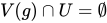 and
and  If
If  is regular at every point, we call regular. Let
  be the ring of regular functions on . In particular, every polynomial is regular and if
  , then
  . Now consider the case
  , for a prime ideal , and take the correspondence
 ![{\displaystyle k[x_{1},\cdots ,x_{n}]=R\ni f\longmapsto f|_{Z}\in {\mathcal {O}}(Z)}](https://wikimedia.org/api/rest_v1/media/math/render/svg/1756d95fd3cfc1a09f7e0ad351f3a7a1e76b58d9) Clearly the kernel of this map is the ideal of polynomials that are zero over , which is, by what was proved before, to be
Clearly the kernel of this map is the ideal of polynomials that are zero over , which is, by what was proved before, to be  (the radical of a prime ideal is the ideal itself). So, we have a 1-1 map
  . This map is not only 1-1, but also onto, so
  To prove it, consider
  , then for every point
  there is an open
  and polynomials
  such that
  and
and  Since is a subspace of a Noether space, it is Noether space itself and it is compact, so there are
  such that
  . Now, by definition
  on the open subspace
  . But, an open subspace of an irreducible space is dense, therefore
  on all . By definition, every point
  belongs to the complement of some
  , therefore
  But, by Hilbert's Nullstellensatz, if the ideal
  is proper, it would have a zero, contrary to the last equation, therefore it must be equal to , so there is are
  such that
  which means that
  over . Now, consider the polynomial
  , then for every and
 so, since
  , we conclude that
  and, since the same can be done for every , we conclude that
  in , proving surjectivity.
- Morphism of varieties. Consider two quasi-affine varieties
 , then a function
  is a morphism of varieties if there are
  such that
  Consider now
  and
and  and define
  . Now, consider
  and
and  , then there is
  and polynomials
  such that
  and
and  Now, there are open neighborhoods
  of
of  and polynomials
  such that
  and
and  So, in the open neighborhood
  of
of  Finally, we just need to collect all the
  at denominator, so that we are left with a quotient of polynomials multiplied by powers (eventually negative) of 's. The result is that, Given a morphism of varieties, this induces a morphism between structure sheaves
 On the other hand, a function with the previous property is a morphism of varieties, since
 where
where  is the
  -th projection (which is equal to the polynomial
  , therefore
  ). In particular, a morphism
  is regular if and only if it induces a map
  . In particular, we have a morphism
  At the same time, to a morphism
  we can associate the map
  which is a map
  . Suppose
  , for some prime , (so
  is an affine variety) and take
  , then given
 since
since  (because , thus
  by definition). Thus
  is a morphism
  . Clearly
  (since the -th coordinate of
  is
is  ). On the other hand,
  which means that
  , since
  generate
  as a -algebra. Thus Given a variety and quasi-variety , there is an isomorphism
  Notice that every
  is an integral domain (since it is isomorphic to
  , where
  and is prime) and a -algebra of finite type. On the other hand, given a -algebra of finite type that is a domain
 ![{\displaystyle k[x_{1},\cdots ,x_{n}]\rightarrow A}](https://wikimedia.org/api/rest_v1/media/math/render/svg/a6bf04bb7987ca542162b3e4b1ddf4ceacc6d415) the kernel is a prime ideal (since the quotient by the kernel is isomorphic to , an integral domain), therefore
the kernel is a prime ideal (since the quotient by the kernel is isomorphic to , an integral domain), therefore ![{\displaystyle A\simeq k[x_{1},\cdots ,x_{n}]/{\mathfrak {p}}\simeq {\mathcal {O}}(V({\mathfrak {p}}))}](https://wikimedia.org/api/rest_v1/media/math/render/svg/ec62f91ba6902fb96849d6ab7df92d0986b180f4) So Every -algebra of finite type that is an integral domain is isomorphic to an algebra , for some affine variety . This proves (together with the previous result) that the category
So Every -algebra of finite type that is an integral domain is isomorphic to an algebra , for some affine variety . This proves (together with the previous result) that the category  of affine varieties is equivalent to the category of domains of finite type over .
- Isomorphism of affine and quasi-affine varieties. Consider an affine variety
 and
and ![{\displaystyle f\in R=k[x_{1},\cdots ,x_{n}]}](https://wikimedia.org/api/rest_v1/media/math/render/svg/361071bd03133235e60980f2ccc06c7f4c6c7dda) , then
, then  is a quasi-affine variety defined as the locus of zeros of which are not zeros for . Consider now the ideal
 ![{\displaystyle {\mathfrak {r}}\subseteq k[x_{1},\cdots ,x_{n},t]}](https://wikimedia.org/api/rest_v1/media/math/render/svg/31ddf7c8b41b30f10990aa0f39738ea1807b6e51) generated by and
generated by and  , where
 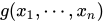 is a polynomial such that
  . Consider now the two maps
  and
and  Both maps are clearly morphisms of varieties (in particular, they are continuous) and are inverse of one another, therefore
  . Now, is the open subspace of an irreducible space, therefore it is irreducible as well and so is
  , thus
  is prime and is an affine variety. A quasi-affine variety
  is isomorphic to an affine variety
- In particular, consider a quasi-affine variety
 (by definition a quasi affine variety is the complement in an affine variety of an affine variety). For a point
  there is a
  such that
  , so
, so  and is isomorphic to an affine variety, thus Every point of a quasi-affine variety has a neighborhood isomorphic to an affine variety.
Spectrum and localization
- Spectrum of a ring. Given a ring , let
 be the collection of prime ideals in , while let be the collection of the maximal ideals. On we define the Zariski topology with closed spaces
 for a generic ideal of . Given a multiplicative set (i.e. and
  ), let be the localization of at . We denote by
  the localization at
  .
.
- Absolutely flat rings. Let be absolutely flat (that is, for every there is
 such that
  ). If is local, then
  implies that either is a unit or that belongs to the unique maximal ideal of , which implies that
  , which means that
  is a unit and
  , so An absolutely flat, local ring is a field. In particular, if is a multiplicative subset, then is absolutely flat, so if we take , we have that
  is an absolutely flat, local ring, therefore it is a field. So If is absolutely flat, then is a field, for every prime ideal . On the other hand,
  where the first equality comes from the isomorphism
  , for -modules
  . In particular,
  are ideals in , which is a field, so they are equal and their quotient zero. So
  which implies
  . So is absolutely flat if and only if is a field, for every prime . Consider the canonical map , the induced map
  this map has an inverse, sending into
  (which is a prime ideal). The two maps are inverses of each other, thus they are 1-1 onto. In particular, consider absolutely flat and
  , with prime, then
  clearly the condition
  is equivalent to
  , so In an absolutely flat ring, there is no strict inclusion between prime ideals. Suppose that every prime ideal is maximal. Given a prime ideal
  , we have the following chain of morphisms
  the second map is an homeomorphism (easy to prove). The first map has image the prime ideals in
  contained in , which are in 1-1 correspondence with the prime ideals contained in
  . But, by hypothesis, every prime ideal is maximal, thus
  has a unique element
  But, this means that the nilradical of
  is (since the nilradical is the intersection of all prime ideals), but the nilradical of
  is
is  , for
, for  the nilradical of . In this case
  so
so  is the unique prime ideal and is a field, for every prime , so is absolutely flat. Since
  , we can assume that our ring has
  and is thus absolutely flat. Then for
  there is
  such that
  so
so  and
and  , so if the quotient is absolutely flat, then is Hausdorff and totally disconnected.
- Torsion module. Consider a module and define
 , called torsion submodule, as the submodule of elements
  such that
  is non zero. A module such that
  is called torsion free and
  is one such modules.
- Faithfully flat rings. Consider
 such that is a flat -algebra. Consider the following exact sequence
  Tensoring with we still have an exact sequence (since is flat)
  but
but  is 1-1, since it has a retraction
  , so
, so  . So, For a flat -algebra , we have that the map
  is 1-1 if and only if
  implies
  . On the other hand, suppose
  is 1-1, for every -module . Consider prime, then
  But is 1-1, so the kernel of (which is equal to
  ) is equal to the kernel of , so
  So if the map is 1-1, then , for every prime ideal
  . Now we show that implies
  , for some
  : Take
  , then there is a prime ideal
  disjoint from
  and containing
  , so
, so  and
and  , so and
  is onto. Now, clearly this implies that for every maximal ideal , we have
  (otherwise, for a prime ideal
  , it would imply that
  ), so if
  is onto, then for every maximal ideal . Finally, suppose for a maximal ideal , we have . Take a non zero , we have the following exact sequence
  where is a maximal ideal containing and the last map is
  . Tensoring with we still have the exact sequence
  if
if  , then
  . But,
  (since
  ), implying
  , absurd, so
  is non zero. Therefore, if
  for every maximal ideal , then implies , for every -module . If any of the previous equivalent conditions is verified by a flat -algebra , then we say that is a faithfully flat -algebra.
- Fibers. Consider a morphism
 and a prime ideal , then let
  be the localization at
  , so the map
  restricts to a map
  (where we can identify
  with the ideals in
  contained in ). Now, given a morphism and an ideal , then the morphism restricts to
  (where we can identify
  with the ideals in containing ). Therefore, the map
  restricts to a map
  therefore the fiber
  is homeomorphic to
  of
of  (where
  is the residue field of ). Therefore, given a morphism
  , we call
  the fiber of over .
Grassmanian Manifold
- Grassmanian coordinates. Let
 be the collection of -dimensional subspaces of
  . From
  we take
  points
 ![{\displaystyle x^{j}=[x^{j}{}_{i}]}](https://wikimedia.org/api/rest_v1/media/math/render/svg/ac9a247e703318ddc34eb9e25560615b9f3a6d9f) which generate the subspace, then the matrix
which generate the subspace, then the matrix  has rank , meaning that the minors of order don't all have zero determinant
![{\displaystyle \mathbb {G} _{n,k}\longrightarrow \mathbb {P} ^{{\binom {n+1}{k+1}}-1},\qquad X\longmapsto [p_{i_{0},\cdots ,i_{k}}]}](https://wikimedia.org/api/rest_v1/media/math/render/svg/822a6b99c9264e3e31af55809b9f578eb391b4f2) where
where  is the minor of the previous matrix from the columns
  (picking different points only changes the matrix by a constant factor, resulting in the same point in the projective space).
Sheave and Schemes
- Sheaves. Given a functor
 , this induces a map
 ![{\displaystyle p_{*}:[D,\mathbf {Set} ]\rightarrow [C,\mathbf {Set} ]}](https://wikimedia.org/api/rest_v1/media/math/render/svg/98bc5eb257855da3b8ada7b58b0f482c7f65b25b) given by precomposition with
given by precomposition with  . Now, given an object
  we define the category
  with objects the pairs
  with a morphism
  is a morphism
  such that
  . Now, given a copresheaf
  , we define the following diagram
  (where is the projection
  onto the first component). Since
  is complete, assuming that the categories involved are small enough, the following definition makes sense
 The functor
  is called inverse image functor. Now, given a natural transformation
  we can define for each a cone
  by sending
  to the map
  it easy to prove from the definition of morphism in that this is a cone, therefore there is a unique lift to a map
  , with this is easy to prove that
 ![{\displaystyle p^{*}:[C,\mathbf {Set} ]\rightarrow [D,\mathbf {Set} ]}](https://wikimedia.org/api/rest_v1/media/math/render/svg/4951e35d973b20d9d8c63555838932d500b22d70) extend to a functor which is a left adjoint to
extend to a functor which is a left adjoint to  .On the same vein, define the category
  and
and  where
where  is the projection like the one above. The functor
  is right adjoint to , so that we have the following triple of adjunction
 ![{\displaystyle p^{*}\dashv p_{*}\dashv p_{!}:[C,\mathbf {Set} ]\rightarrow [D,\mathbf {Set} ]}](https://wikimedia.org/api/rest_v1/media/math/render/svg/51d41e311b88385aa812526ec4e8c86bd4e8e3e3) we call this an effective geometric morphism between
we call this an effective geometric morphism between ![{\displaystyle [C,\mathbf {Set} ]}](https://wikimedia.org/api/rest_v1/media/math/render/svg/82279eebf2ca9bb7ea6f2eeeb8c3c479f193900d) and
and ![{\displaystyle [D,\mathbf {Set} ]}](https://wikimedia.org/api/rest_v1/media/math/render/svg/ab4d3a80f9b5bf2329696f90ad6d4310fd610c02) .
.
- Geometric morphism for presheaves on topological spaces. Consider the case of a continuous map and set
![{\displaystyle [X,\mathbf {Set} ]:=[O(X)^{op},\mathbf {Set} ]}](https://wikimedia.org/api/rest_v1/media/math/render/svg/69b9d904b3fb47bd281d25bc462de409d4f9ec74) (with
(with  the topology of the space ). The map induces a functor
  between the categories of open subsets. This, in turn, define first a functor
 ![{\displaystyle f_{*}:[X,\mathbf {Set} ]\rightarrow [Y,\mathbf {Set} ]}](https://wikimedia.org/api/rest_v1/media/math/render/svg/c0d70efd2a5895b8d7027a90c741da354d3b7ed6) and then, by the above construction (and the fact that is always small, for every space), we other two functors, namely
and then, by the above construction (and the fact that is always small, for every space), we other two functors, namely  . By unraveling the definition above, the two functors are defined as
  In particular, we can induce another adjunction
  by restricting
  to
to  ( preserve sheaves), while restricting to
  and the map
  to its associated sheaf. In particular, given a point
  , we call
  the skyscraper functor, while we call the functor
  is called the stalk functor at , we also indicate
  .
.
- Scheme. Consider a commutative ring and the corresponding spectrum . Let , for a point
 , the localization at the complement of . Given
  open, we define
  as the space of the sections
  of the map
  sending to , such that for each there is a cover
  and
and  and
and  such that
  for every
  and
and  We call the pair
  a spectrum. A ringed space is a pair
  made of a topological space and a sheaf of rings
  , then every affine scheme is a ringed space. A morphism of ringed spaces
  is a continuous function and a sheaf homomorphism
  The space is called locally ringed space if the stalk
  at every is a local ring. A morphism of locally ringed spaces is a morphism of ringed spaces, such that, for each , the induced map on stalks
  is a map of local rings (that is, counterimage of the maximal ideal in
  is the maximal ideal in
  ). A ringed space is an affine scheme if
  for some ring . We call
  the structure sheaf. Given a spectrum , notice there is a map, for every containing
  this map induces a morphism
  which is onto: For every
  , with
  , take
  , then
  for every
  , by definition, so define
  as constant
  , then
  , proving surjectivity. As per injectivity, if
  , for , then there is
  such that
  , but then take
  (since
  , so
, so  ), where
  is an open neighborhood of such that
  in , thus
  for every
  , and so
  in every
  . So
. So  In particular, notice that is a local ring, therefore
  is a local ring and is a locally ringed space. A scheme is a locally ringed space for which there is a cover
  such that
  is an affine scheme.