User:Gmenta/Draft of article2
Antenna Theory
In antenna theory, the isotropic radiator is a theoretical radiator having a directivity of 0 dBi (dB relative to isotropic), which means that the radiator equally transmits (or receives) electromagnetic radiation to/from any arbitrary direction.
In reality, a coherent isotropic radiator cannot exist, as the isotropic radiator, with a radiation pattern (as expressed in spherical coordinates) of
- (note that the magnitude of this function is independent of the spherical angles and , but it is permissible for the vector's direction, as represented by the unit vector to be a function of and )
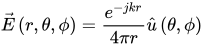


would violate the Helmholtz Wave Equation, as derived from Maxwell's Equations.
Although the Sun and other stars radiate equally in all directions, their radiation pattern does not violate Maxwell's equations, because radiation from a star is incoherent. Sound waves can also expand uniformly in all directions, but sound waves are longitudinal waves and not transverse waves.
Even though an isotropic radiator cannot exist in practice, antenna directivity is usually compared to the directivity of an isotropic radiator, because the gain (which is closely related to directivity) relative to an isotropic radiator is useful in the Friis transmission equation. The smallest directivity a radiator can have relative to an isotropic radiator, is a Hertzian Dipole, which has 1.76 dBi.
Hairy ball theorem
Another way to explain why an isotropic radiator cannot exist is by using the hairy ball theorem, which asserts that a continuous vector field tangent to the surface of the sphere, must fall to zero at at least one point on the sphere. This means that there is some direction for which the electric field must be zero, and hence, non-uniform.
Quasi-ideal isotropic receiver

In EMF measurements applications, an isotropic receiver (also called isotropic antenna), is a field measurement instrument which allows to obtain the total field independently of the tri-axial orthogonal arrangement chosen for orientation of the device itself.
In practice a quasi-ideal isotropic receiver is obtained with three orthogonal sensing devices with a radiation diagram of the omnidirectional type , like that of short dipole and small loop antennas.

The parameter used to define accuracy in the measurements is called isotropic deviation
Content Disclaimer
Informasi ini disarikan dari Wikipedia dan disajikan kembali untuk tujuan edukasi. Konten tersedia di bawah lisensi CC BY-SA 3.0. Kami tidak bertanggung jawab atas ketidakakuratan data yang bersumber dari kontribusi publik tersebut.
- The information displayed on this website is sourced in part or in whole from Wikipedia and has been adapted for the purpose of restating it. We strive to provide accurate and relevant information, however:
- There is no guarantee of absolute accuracy. Wikipedia is an open, collaborative project that can be edited by anyone, so information is subject to change.
- It is not intended to constitute professional advice. The content displayed is for informational and educational purposes only. For important decisions (e.g., medical, legal, or financial), please consult a professional.
- Content copyright. Wikipedia is licensed under the Creative Commons Attribution-ShareAlike License (CC BY-SA). This means that content may be reused with appropriate attribution and shared under a similar license.
- Responsible use. Any risk arising from the use of information from this website is entirely the responsibility of the user.