User:MathInvestigator/sandbox

Hilbert's thirteenth problem
Hilbert's thirteenth problem is one of the 23 Hilbert problems set out in a celebrated list compiled in 1900 by David Hilbert. It entails proving whether a solution exists for all 7th-degree equations using continuous (variant: algebraic) functions of two arguments.
It was first presented in the context of nomography, and in particular "nomographic construction" — a process whereby a function of several variables is constructed using functions of two variables. Hilbert conjectured that general case of septic equation cannot be solved using algebraic functions of two variables. Later he generalized this to continuous functions and stated that even acceptable solution for this problem would be to prove existence of analytic function of three variables that cannot be written as finite composition of two-variable continuous function.
The variant for continuous functions was disproven in 1957 by Vladimir Arnold when he proved the Kolmogorov–Arnold representation theorem, but the variant for algebraic functions remains unresolved.
Original statement
In 1902 article there is detailed explanation of nomography and Tshirnhaus transformations. After this introduction there is statement of the problem:
Now it is probable that the root of the equation of the seventh degree is a function of its coefficients which does not belong to this class of functions capable of nomographic construction, i.e., that it cannot be constructed by a finite number of insertions of functions of two arguments. In order to prove this, the proof would be necessary that the equation of the seventh degree:
is not solvable with the help of any continuous functions of only two arguments. I may be allowed to add that I have satisfied myself by a rigorous process that there exist analytical functions of three arguments x, y, z which cannot be obtained by a finite chain of functions of only two arguments.

Background
For every one-variable polynomial:

By its resolving function we mean algebraic function such that after substitution we have:


Intuitively, this function can be thought as formula for roots of this polynomial depending of its coefficients. Polynomials up to degree 4 can be solved by radicals. Equivalently, their resolving functions can be written using finite composition of one-variable algebraic functions:
![{\displaystyle f(x)=-x,\quad f(x)={\frac {1}{x}},\quad f(x)={\sqrt[{n}]{x}}\ {\text{for}}\ n\geq 2}](https://wikimedia.org/api/rest_v1/media/math/render/svg/28cdba99ee3a6f545fdcd51d3d3c6d7a382f93af)
And using two-variable algebraic functions:

Using Galois theory it can be showed that for degree 5 and greater there exist polynomials that cannot be solved by radicals. Polynomial can be solved by radicals exactly when spliting field of this polynomial have solvable Galois group over field of coefficients of such polynomial. However, using Tschirnhaus transformations general case of n-th degree polynomial:

can be reduced by radicals, to form:

Tschirnhaus transformation allows to express algebraic function as finite composition of function with one and two-variable functions used in solution by radicals. For polynomials of 5th and 6th degree general case can be reduced to:


From this we can see that function resolving general polynomial of 5th degre can be obtained as finite composition of solution by radicals operations and some one-variable algebraic function and function resolving every 6th degree polynomial can be obtained as finite composition of solution by radicals operations and some two-variable algebraic function . In the same way, every seventh-degree equation can be reduced via radicals to the form:



Then every function resolving 7th degree equation can be obtained by finite composition of solution by radicals operations and some three-variable algebraic function: . Possiblity of resolution of septic equations by two-variable algebraic function depends of whether this three-variable algebraic function can be composed from two-variable algebraic functions.

Hilbert conjectured that 7th degree should be similar limit to solution by algebraic functions of two variables like the 5th degree is for solution by radicals. In 1902 article presenting his list of 23 problems, there is even stronger conjecture: that this function shouldn't be obtained using even continuous functions of two variables. From description follows that he accepted possibility that functions resolving septic polynomials (or possibly another algebraic functions) may be obtained in such way, but he still believed that there should be three-variable analytic functions that shouldn't be obtained from two-variable continuous functions.
Status
There are controversies about class of functions that problem should concern and whether this problem is resolved or not. In 1902 English article describing Hilbert's problems it is stated that problem concerns class of continuous functions. This variant of problem was resolved negatively by Vladimir Arnold and Kolmogorov-Arnold representation theorem in 1957.
However, later Hilbert (1927) article in German suggest that he originally intended for a solution in a class of algebraic functions. Some autors are motivated by this for their own work in field of algebraic functions and seeking possible extension of Galois theory. Arnold himself who solved continuous variant, later returned to the algebraic version of the problem, jointly with Goro Shimura.
Continuous variant
Stronger variant of this problem for continuous functions was resolved: for the class of continuous functions Hilbert's conjecture is false.
In 1956, Andrey Kolmogorov showed that any multivariate continuous function can be constructed with a finite number of three-variable functions. In in 1957, Vladimir Arnold, then a student of Kolmogorov improved his result to use only one-variable functions and summation. Kolmogorov-Arnold representation theorem says that every continuous, real function of several variables can be expressed as:

Where continuous functions are universal and independent of the represented function, but continuous are dependent of represented function. Arnold's result was later improved by George Lorentz, as he reduced number of outer functions and showed that it is enough to choose only one function dependent on :
![{\displaystyle \phi _{i,j}:[0,1]\rightarrow \mathbb {R} }](https://wikimedia.org/api/rest_v1/media/math/render/svg/be1dbf306d649900c3ab0681da403c5c5b3f9e42)


David Sprehner given onother improvement to show that number of inner functions can be reduced to one function but using appropriate shift in argument and multiplication by constants .


Kolmogorov-Arnold theorem and its finer versions can be interpreted that two-variable addition can be considered as only "truly multivariate" function in a class of continuous functions. As every algebraic and analytic functions are continuous, then Kolmogorov-Arnold theorem disproves stronger variant of Hilbert conjecture, even for a case of multivariate analytic functions.
Algebraic variant
Due to much smaller class of functions that can be used for representation, conjecture stated by Hilbert is still unresolved in class of algebraic functions.
Despite results to improve Kolmogorov-Arnold theorem, it failed to give finer version that can represent even multivariate smooth functions using two-variable smooth functions.
Brauer (1975) introduced conception of resolvent degree for polynomial-the smallest number such that function resolving polynomial can be written as finite composition of algebraic functions of at most variables. Independently resolvent degree was defined by Arnold & Shimura (1976). In this framework results presented in this article can be stated:

- Tshirnhaus transformations shows that resolvent degree of polynomial is at most .
- For polynomials of degree at most 6 their resolvent degree is 2.
- Algebraic variant of Hilbert's 13th problem is to show that there exists septic polynomials that have resolvent degree 3.

References
- Shreeram Shankar Abhyankar, "Hilbert's Thirteenth Problem", Algèbre non commutative, groupes quantiques et invariants (Reims, 1995), 1–11, Sémin. Congr., 2, Soc. Math. France, Paris, 1997. MR 1601178
- V. I. Arnold and Goro Shimura, Superposition of algebraic functions (1976), in Mathematical Developments Arising From Hilbert Problems, Volume 1, Proceedings of Symposia in Pure Mathematics 28 (1976), pp. 45-46.
- Arnold, Vladimir; Shimura, Goro (1976). "Superposition of algebraic functions". Proceedings of Symposia in Pure Mathematics. 28. AMS: 45-46.
- Brauer, Richard (1975). "On the resolvent problem". Ann. Mat. Pura Appl. 102 (4): 45-55.
- Hilbert, David (1927). "Über die Gleichung neunten Grades". Mathematische Annalen. 97 (1): 243–250. doi:10.1007/BF01447867. JFM 52.0103.02. MR 1512361.
- Lorentz, George G. (1966). Approximation of Functions. New York Chicago Toronto: Holt, Rinehart and Winston. Chapter 11. MR 0213785.
- Vitushkin, Anatoli Georgievich (2004). "13-я проблема Гильберта и смежные вопросы" (PDF). Uspekhi Matematicheskikh Nauk. 59 (1): 11–24. doi:10.4213/rm698. English translation in: Vitushkin, A. G. (2004). "On Hilbert's thirteenth problem and related questions". Russian Mathematical Surveys. 59 (1): 11–25. Bibcode:2004RuMaS..59...11V. doi:10.1070/RM2004v059n01ABEH000698. MR 2068840.
- Farb, Benson; Wolfson, Jesse (2020). "Resolvent degree, Hilbert's 13th Problem and geometry". L'Enseignement mathématique. 65 (3): 303–376. arXiv:1803.04063. doi:10.4171/LEM/65-3/4-2. ISSN 0013-8584. MR 4113045. S2CID 14000951.
See also
External links
- Ornes, Stephen (14 January 2021). "Mathematicians Resurrect Hilbert's 13th Problem". Quanta Magazine.
Hilbert's eleventh problem
Hilbert's eleventh problem is one of David Hilbert's list of open mathematical problems posed at the Second International Congress of Mathematicians in Paris in 1900. The literal statement of the problem asks for development of general theory of quadratic forms over number fields, including representations of numbers by quadratic forms when substituting algebraic numbers from this field or algebraic integers from ring of integers in this field. Since classification of quadratic forms is closely related problem, in later interpretations it was also extended to classification of quadratic forms over any number field and its ring of integers.
For the number fields, the problem was originally resolved in series of articles published by Helmut Hasse in years 1923-1924 which introduced local-global principle, but more brief and elegant theory that allowed to obtain Hasse results was later developed by Ernst Witt in 1937 using Witt groups of isotropic forms and ring structure that can be put on them.
For the rings of integers, there is still no general theory of representation of numbers by quadratic forms and the topic is source of open problems.
Original statement
A furthering of the theory of quadratic forms, he stated the problem as follows:
- Our present knowledge of the theory of quadratic number fields puts us in a position to attack successfully the theory of quadratic forms with any number of variables and with any algebraic numerical coefficients. This leads in particular to the interesting problem: to solve a given quadratic equation with algebraic numerical coefficients in any number of variables by integral or fractional numbers belonging to the algebraic realm of rationality determined by the coefficients.[1]
Background
A quadratic form (don't confuse with quadratic equation) is homogenous multivariate polynomial. The general form of such an equation is:

where coefficients are in some ring . Alternatively quadratic forms can be defined using symmetric bilinear mappings on finitely generated free -module, by:


From this notation, number of variables in quadratic form is called dimension. Two quadratic forms are said to be equivalent when there is invertible linear mapping with coefficients over such that:

We say that a quadratic form represents element , when there is substitution of elements , such that:


Centuries before Hilbert quadratic forms over become point of interest in number theory, especially representation of numbers by them. For example, sum of two squares theorem gives equivalent condition for nonnegative intetger to be represented by quadratic form:


Another example is Lagrange's four-square theorem which says that says that every non-negative integer is represented by quadratic form:

without any additional conditions. Similar problems can be considered for representation of rational numbers by quadratic forms over .

Classification of equivalent quadratic forms origins from geometry, where classifacation over lead to classsification of conic sections or quadrics. From number-theoretic point of view classification of quadratic forms over or is interesting, because two equivalent quadratic forms represents the same numbers, only specific substitutions changes. Sometimes one of the equivalent forms is easier to deal with. Gauss used in his own proof of Lagrange theorem that sum of four squares is equivalent over to[2]:


Over real numbers general classification of quadratic forms is provided by Sylvester's law of inertia. Classification over it is even simpler, since non-degenerated complex quadratic forms are classified only by their dimension.

Classification of quadratic forms over was provided by Hermann Minkowski in 1890, as well as representation of rational numbers by them. Hilbert himself in 1899 paper proved that a quadratic form:

In modern mathematical language, Hilbert's eleventh problem is a question about general theory of quadratic forms over any number field (solution by fractional numbers) or its ring of integers (solution by integral numbers)-especially representation of algebraic numbers by them, which is a natural way to generalize results like sum ot two square theorem or Lagrange theorem into context of algebraic number theory. Since classification of quadratic forms is very closely related question it is usually treated as a part of general theory demanded in a problem.
Status
For number fields the problem was resolved relatively quickly after the publication of the Hilbert's list. General theory of classification and representation of numbers by substitution from number field was introduced by Helmut Hasse in 1924. Hasse results was put into more elegent and simpler framework by Ernst Witt in 1938, using Witt theorem and notation of Witt groups and Witt rings of anisotropic forms.
However, the representation of numbers by substitution from rings of integers that Hilbert asked for is much more difficult and is still source of open problems.
Number fields
Minkowski result for rational numbers was successfully generalized by Helmut Hasse who developed general theory for classification of quadratic forms and representation of numbers by them for any number field. In the series of five articles Hasse replaced p-adic complections or rationals by non-archimedean completions of number fields and real numbers by archimedean completions and proved local-global principle for quadratic forms.
Local-global principle says that number is represented by quadratic form with coefficients over number field if and only if it is represented in completion for any place on (including archimedean places). Using local-global principle, Hasse also proved Hasse–Minkowski theorem for classification of quadratic forms: two forms are equivalent if and only if they are equivalent in completion for every plave . This reduced the problem to essentially three cases:


- if is complex place: , equivalence of two non-degenerated forms is determined only by their dimension. Every number is represented by any non-degenerated quadratic form.
- if is real place: , equivalence of two forms is determined by Sylvester's law of inertia. Every nonnegative number is represented by any non-degenerated quadratic form.
- if is non-archimedean place: is finite extension of , equivalence of two non-degenerated forms of the same dimension is determined by Hasse invariant. Analytic methods like Newton method or p-adic Hensel lemma can be used to decide representation of number.


In 1937 Ernst Witt introduced more general theory of quadratic forms, that works when field characteristic is different than 2. In such case Witt theorem gives decompositon of finite-dimesional vector space equipped with with quadratic form into:

where is kernel of quadratic form, is anisotropic space called core form and is isotropic quadratic space. From Witt theorem also follows cancellation law that provides uniqueness of such factorization. Two finite-dimensional spaces are treated as equivalent when one can be obtained from second by adjoining isotropic quadratic space. This new equivalence relation is wider than classical equivalence of quadratic forms, which is adjoining a trivial hyperbolic space.


Set of core forms with direct sum action have group structure, in this way the Witt group for a given field is defined. Using tensor product of quadratic forms, Witt group can be equipped with compatible multiplicative structure giving commutative ring, called Witt ring. In Witt ring the core forms act as representants of equivalence classes of quadratic forms. Algebraic structure of ring introduced on anisotropic forms is helpful when dealing with finding all equivalence classes of isotropic forms explicitely.
Knowing Witt ring of a given field provides a complete classification of quadratic forms over a given field. Despite Witt ring itself contains only equivalence classes of anisotropic parts of quadratic forms, isotropic part is easier to deal with. If field characteristic is different than 2, the isotropic form can be decomposed into finite copies of hyperbolic quadratic planes:

If field characteristic is different than 2, hyperbolic quadratic planes are equivalent, then every non-degenerated quadratic form can be represented as:

Including also dimension of kernel, knowledge about anisotropic forms provides classification of general quadratic forms. In language of Witt rings Hasse-Minkowski theorem is equivalent to existence of ring monomorphism when is number field with places :

Theory developed by Hasse and Witt is generally accepted as a solution for Hilbert's 11th problem for number fields.
Rings of integers
The problem for number rings is much more complicated, but seems more relevant for possible generalizations of results like Lagrange theorem for integers. Rings of integers lack strong approximation that is a basis of Hasse principle, also theory developed by Witt that extensively uses properties of vector spaces usually fails in case of modules.
Known counterexample for Hasse principle in is Ramanujan's quadratic form:

There are known 18 exceptional numbers: 3, 7, 21, 31, 33, 43, 67, 79, 87, 133, 217, 219, 223, 253, 307, 391, 679, 2719 that aren't represented by this form with integer substitutions, despite having local representations for all places of integers. Currently it is open problem whether the list of exceptional numbers for Ramanujan's form is complete. Ono & Saudararajan (1997) showed that under assumption of Generalized Riemann Hypothesis for Hasse-Weil L-functions.
There are further research to explain why Hasse principle fails for number rings and in which cases, involving arithmetic geometry of quadratic forms. One of the identified reasons is Manin obstruction, but this don't resolves problem of exceptional numbers completely as it is no clear whether aren't another reasons. Currently there is no counterpart of Hasse principle that would relate local and global representations and deal with all exceptions.
An example is the work of Cogdell, Piatetski-Shapiro and Sarnak.[3]
Further information
Since Witt theory works for every field of characteristic different than 2, Witt rings express classification of quadratic forms over real and complex numbers. Over complex numbers every non-degenerated quadratic forms of the same dimension are equivalent and hyperbolic plane form have dimension 2, than only parity of dimension matters:

For real numbers Sylvester's law of inertia and signature of the form can be classified as:

Minkowski classification of quadratic forms over rational numbers can be expressed as:

Theory of Witt ring provides full classification of quadratic forms, but is not effective for explicit classification which requires explicit form of the ring. Embedding of Witt ring for a number field can be used in computing explicit form of the ring since:
- for complex place:
- for real place:
- if maximal ideal norm congruent to 1 modulo 4:
- if maximal ideal is congruent to 3 modulo 4:
![{\displaystyle W(K_{v})=\mathbb {Z} /2\mathbb {Z} [K]}](https://wikimedia.org/api/rest_v1/media/math/render/svg/720939639f56091d5bc1b4831f51982556c33de8)
![{\displaystyle W(K_{v})=\mathbb {Z} /2\mathbb {Z} [C_{2}]}](https://wikimedia.org/api/rest_v1/media/math/render/svg/f58f0cc9b55eb040f196d02313598dd1e01446b6)
The explicit form of local fields being finite extensions of finding Witt rings is more complicated task.

See also
Notes
- ^ David Hilbert, "Mathematical Problems". Bulletin of the American Mathematical Society, vol. 8, no. 10 (1902), pp. 437-479. Earlier publications (in the original German) appeared in Göttinger Nachrichten, 1900, pp. 253–297, and Archiv der Mathematik und Physik, 3rd series, vol. 1 (1901), pp. 44–63, 213–237.
- ^ Yandell, Ben (2002). The Honors Class : Hilbert's problems and their solvers. Natick, Mass.: A.K. Peters. pp. 245–255. ISBN 1-56881-141-1. OCLC 47644376.
- ^ Cogdell, James W. (2003). "On sums of three squares" (PDF). Journal de Théorie des Nombres. 15: 33–44.
References
- Yandell, Benjamin H. The Honors Class: Hilbert's Problems and Their Solvers. Natik: K Peters. Print.
- Ono, Ken; Soundararajan, K. (1997), "Ramanujan's ternary quadratic form", Inventiones Mathematicae, 130 (3): 415–454, Bibcode:1997InMat.130..415O, doi:10.1007/s002220050191, S2CID 122314044
Birch and Swinnerton-Dyer conjecture
| Millennium Prize Problems |
|---|
In mathematics, the Birch and Swinnerton-Dyer conjecture (often called the Birch–Swinnerton-Dyer conjecture) describes the set of rational solutions to equations defining an elliptic curve. It is an open problem in the field of number theory and arithmetic geometry and is widely recognized as one of the most challenging mathematical problems. It is named after mathematicians Bryan John Birch and Sir Peter Swinnerton-Dyer, who formulated the conjecture in the 1960s with the help of machine computation.[1]
The conjecture states that for an elliptic curve over number field the rank of abelian group of -rational points on equals to order of zero of its associated L-function at the point . Since this function depends only on behavior of reductions of modulo prime ideals in , the Birch and Swinnertor Dyer conjecture can be thought as local-global relationship.


The conjecture variant for the curves over was chosen as one of the seven Millennium Prize Problems listed by the Clay Mathematics Institute, which has offered a $1,000,000 prize for the first correct proof.[2] There are also refinements of conjecture to predict expression of first non-zero coefficient in Taylor series at in terms of arithmetic data of over as well as generalizations to algebraic varietes other than elliptic curves.
Background
The problem of finding rational points or more generally, K-rational points on curve is a problem that came from number theory as a method of deciding existence and finding solutions to Diophantine equations. In general, for curve the set of -rational points can be subtle and difficult to determine. However, can strictly depend on genus of the curve.


The curves of genus either have no rational point or have infinitely many rational points, and all of them can be found by rational parametrization. For curves of genus , Faltings theorem says that is finite set, though it not provide method for finding all points or even determine exact number of them. The most elusive case remains and smooth curves of genus 1 are precisely the elliptic curves. Since elliptic curves with addition of points have an abelian group structure and is its subgroup, the question rise how it can be used for a problem of rational points.


In 1922, Louis J. Mordell proved Mordell's theorem, stating that for over the group on an elliptic curve is finitely generated.[3] Andre Weil in his 1929 doctoral dissertation generalized Mordell theorem, and proved that for any abelian variety over any number field , the group is finitely generated, especially . From the structure of finitely generated abelian groups follows that must be isomorphic to group:


Where is torsion subgroup of that group consisting of elements of finite order, and is called rank of group . Equivalently, rank is a number of independent elements of infinite order in this group. Although Mordell-Weil theorem shows that the rank of is always finite, it does not give an effective method for calculating it. The rank can sometimes be calculated using numerical methods, but it is currently unknown if these methods are effective for all curves.


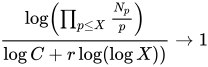
In the early 1960s, Swinnerton-Dyer used the EDSAC-2 computer at the University of Cambridge Computer Laboratory to calculate the number of points modulo for a large number of primes on elliptic curves whose rank was known. From these numerical results, he and his colleage Bryan John Birch conjectured[1] that for a curve with rank , the growth of obeys the asymptotic law


- ,
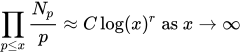
where is a constant. Initially, this was based on somewhat tenuous trends in graphical plots, which aroused a measure of skepticism in Birch's advisor J. W. S. Cassels.[4] Over time, however, the accumulated numerical evidence became convincing. This in turn led Birch and Swinnerton-Dyer to make a general conjecture about the behavior of a curve's L-function at ; namely, that it would have a zero of order at this point. This was a far-sighted conjecture for the time, given that series defining this L-function is not convergent at this point and the analytic continuation was only established for curves with complex multiplication, which were also the main source of numerical examples.






Statement
Let be elliptic curve over number field and be the ring of integers for that number field. Consider reductions of Neron model for modulo prime ideal . Each is variety over finite field , then the Frobenius morphism for this field applied on each coordinate is a regular mapping:


Functoriality of Weil cohomologies means, that this regular mapping induces mapping on Weil cohomologies:

Denote norm of an ideal as . Having norm, the local L-function is defined as:


Clearly we can see, that is reciprocal of polynomial in . This polynomials plays key role in explicit formula for local zeta functions of algebraic varietes over finite fields. Let denote the conductor of , since and are ideals in Dedekind ring, the division relationship between then can be properly defined. The explicit form of local L-function is:


Since conductor carries information about bad reductions of , the form of local L-function is strictly related to behavior of the reduction of modulo :
- the first case is when is a good reduction.
- the second case is when has a cusp.
- the third case is when has a node.
Since only finite number of prime ideals can divide the conductor, almost all reductions are good. Now, the global L-function is defined as an Euler product of L-functions for reductions of modulo prime ideals:

The global L-function can be written as Dirichlet series:

where and can also be described in terms of a trace of Frobenius morphism:


for the rest natural numbers is defined in a multiplicative manner. From Hasse-Weil inequality and multiplicativity follows that:


This guarantee convergence of Dirichlet series defining in half-plane . The series does not naturally converge for complex numbers with lesser real parts, then L-function is expected to have analytic continuation to the rest of complex plane and satisfy functional equation typical for L-function. Expected functional equation allows to distinguish trivial and nontrivial zeros of and is expected to give critical line as a line of symmetry for all nontrivial zeros. The significance of the point comes from fact, that for analytic continuation and functional equation is expected to coincide with some automorphic L-function and from Grand Riemann Hypothesis it should be only real nontrivial zero. The Birch and Swinnerton-Dyer conjecture says that:


This conjecture was first proved by Max Deuring for elliptic curves with complex multiplication.[5]
If is a modular elliptic curve, then then Hasse-Weil L-function is L-function for modular form of weight . This guarantees analytic continuation and functional equation for this function. For elliptic curves with complex multiplication this was proven by Max Deuring. From modularity theorem follows that if is elliptic curve over , then this curve is modular.

History
By the modularity theorem proved in 2001 for elliptic curves over ,[citation needed] the left side is now known to be well-defined and the finiteness of Ш is known when additionally the analytic rank is at most 1; i.e., if vanishes at most to order 1 at . For an elliptic curve over a general number field, the finiteness of both sides remains open.

Current status
Currently all elliptic curves for which the analytic continuation of was constructed are modular elliptic curves. This follows from the fact, that for modular elliptic curve coincides with L-function for cuspidal modular form, for which analytic continuation and functional equation was proven in [...]. [...] proven that all elliptic curves with complex multiplication are modular. Moreover the modularity theorem proven by [...] says that all elliptic curves over are modular.
The Birch and Swinnerton-Dyer conjecture has been proved in special cases:
- Coates and Wiles[6] proved that if is a curve over a number field with complex multiplication by an imaginary quadratic field of class number , or , and is not zero, then is a finite group. This was extended to the case where is any finite abelian extension of by Arthaud.[7].
- Gross and Zagier[8] showed that if a modular elliptic curve has a first-order zero at , then it has a rational point of infinite order; see Gross–Zagier theorem.
- Kolyvagin[9] showed that a modular elliptic curve for which is not zero has rank 0, and a modular elliptic curve for which has a first-order zero at has rank 1.
- Rubin[10] showed that for elliptic curves defined over an imaginary quadratic field with complex multiplication by , if the L-series of the elliptic curve was not zero at , then the -part of the Tate–Shafarevich group had the order predicted by the Birch and Swinnerton-Dyer conjecture, for all primes .
- Breuil et al. (2001), extending the work of Wiles,[11] proved that all elliptic curves defined over the rational numbers are modular, which extends results #2 and #3 to all elliptic curves over the rationals, and shows that the L-functions of all elliptic curves over are defined at .
- Bhargava and Shankar[12] proved that the average rank of the Mordell–Weil group of an elliptic curve over is bounded above by . Combining this with the -parity theorem of Nekovář[13] and the work of Dokchitser and Dokchitser[14], and with the proof of the main conjecture of Iwasawa theory for by Skinner and Urban[15], they conclude that a positive proportion of elliptic curves over have analytic rank zero, and hence, by result #3, satisfy the Birch and Swinnerton-Dyer conjecture.


There are currently no proofs involving curves with a rank greater than 1.
There is extensive numerical evidence for the truth of the conjecture.[16]
Consequences
Much like the Riemann hypothesis, this conjecture has multiple consequences, including:
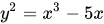
- Let n be an odd square-free integer. Assuming the Birch and Swinnerton-Dyer conjecture, n is the area of a right triangle with rational side lengths (a congruent number) if and only if the number of triplets of integers (x, y, z) satisfying 2x2 + y2 + 8z2 = n is twice the number of triplets satisfying 2x2 + y2 + 32z2 = n. This statement, due to Tunnell's theorem (Tunnell 1983), is related to the fact that n is a congruent number if and only if the elliptic curve y2 = x3 − n2x has a rational point of infinite order (thus, under the Birch and Swinnerton-Dyer conjecture, its L-function has a zero at 1). The interest in this statement is that the condition is easily verified.[17]
- In a different direction, certain analytic methods allow for an estimation of the order of zero in the center of the critical strip of families of L-functions. Admitting the BSD conjecture, these estimations correspond to information about the rank of families of elliptic curves in question. For example: suppose the generalized Riemann hypothesis and the BSD conjecture, the average rank of curves given by y2 = x3 + ax+ b is smaller than 2.[18]
- Because of the existence of the functional equation of the L-function of an elliptic curve, BSD allows us to calculate the parity of the rank of an elliptic curve. This is a conjecture in its own right called the parity conjecture, and it relates the parity of the rank of an elliptic curve to its global root number. This leads to many explicit arithmetic phenomena which are yet to be proved unconditionally. For instance:
- Every positive integer n ≡ 5, 6 or 7 (mod 8) is a congruent number.
- The elliptic curve given by y2 = x3 + ax + b where a ≡ b (mod 2) has infinitely many solutions over .
- Every positive rational number d can be written in the form d = s2(t3 – 91t – 182) for s and t in .
- For every rational number t, the elliptic curve given by y2 = x(x2 – 49(1 + t4)2) has rank at least 1.
- There are many more examples for elliptic curves over number fields.

Refinements and Generalizations
The conjecture was subsequently extended to include the prediction of the leading coefficient in Taylor series of the L-function at .[19] According to refined BSD conjecture, the first non-zero coefficient should equal:
- ,

where:
- is the of the torsion subgroup of .
- is the Tate–Shafarevich group of
- is the real period of multiplied by the number of connected components of
- is the regulator of (defined via the canonical heights of a basis of rational points)
- is the Tamagawa number of at a prime dividing the conductor of (can be computed by Tate's algorithm).


When the conjecture was originally made, little was known, not even whether the left (analytic) side or the right (algebraic) side of this equation were even well-defined. John Tate expressed this in 1974 in a famous quote:[20]
- This remarkable conjecture relates the behavior of a function at a point where it is not at present known to be defined to the order of a group Ш which is not known to be finite!

Abelian varietes
Since Mordell-Weil theorem holds for any abelian variety over number field , the rank of the group of -rational points on is finite number and this case is analogous to elliptic curve.
The L-function for abelian variety is defined:
The generalization of BSD conjecture says that the multiplicity of zero of this L-function at equals rank of group . Note that if , because of Poincare duality for etale cohomologies, the L-function for -st cohomology may be replaced by L-function for -th cohomologies, because that functions satisfy relation:


In this case the point for this L-function where we take zero is .

There is also refinement of conjecture to predict leading coefficient at Tylor expansion. For abelian varieties over the version is the following[21]:

Where:
- and are torison subgroups of -rational points for respectively and dual abelian variety: .
- is Tate-Shafarevich group for .
- is the real period of multiplied by the number of connected components.
- is regulator of , understood for the pairing between a basis for the free parts of and relative to the Poincaré bundle on the product .
- is the Tamagawa number of for primes dividing the conductor of .


Because elliptic curves as a 1-dimensional abelian varieties are self-dual (), formula and definitions of arithmetic invariants for them are simpler.

The rank-one Birch-Swinnerton-Dyer conjecture for modular elliptic curves and modular abelian varieties of GL(2)-type over totally real number fields was proved by Shou-Wu Zhang in 2001.[22][23]
Another generalization is given by the Bloch-Kato conjecture.[24]
Schemes of finite type
For general case of algebraic variety, the concept of rank characteristic for abelian varietes have no sense, then generalization of BSD conjecture to them require different approach.
For arbitrary algebraic variety or more general - any scheme of finite type is to consider the orders of zeros/poles of their arithmetic zeta functions in certain integers, as they are expected to carry important informations about arithmetic invariants of . In example, Serre proved that for scheme of finite type with order of pole at equals to number of connected components of .


Arithmetic zeta function for elliptic curve over is given by:

The BSD conjecture is equivalent to order of pole at the point being: . John Tate proposed a conjecture that for arithmetic zeta function should hold:


Where is a group of invertible regular functions on and is a rank of Piccard group of . Serre theorem and conjecture of Tate inspired Christophe Soulé to propose even more general conjecture about orders of integer points of arithmetic zeta functions:


where are Adams eigenspaces for .

Notes
- ^ a b Birch & Swinnerton-Dyer (1965).
- ^ Birch and Swinnerton-Dyer Conjecture at Clay Mathematics Institute
- ^ Mordell, L. J. (1922). "On the rational solutions of the indeterminate equations of the third and fourth degrees". Mathematical Proceedings of the Cambridge Philosophical Society. 21: 179–192.
- ^ Stewart (2013), p. 253, "Cassels was highly skeptical at first".
- ^ Deuring (1941).
- ^ Coates & Wiles (1977).
- ^ Arthaud (1978).
- ^ Gross & Zagier (1986).
- ^ Kolyvagin (1989).
- ^ Rubin (1991).
- ^ Wiles (1995).
- ^ Bhargava & Shankar (2015).
- ^ Nekovář (2009).
- ^ Dokchitser & Dokchitser (2010).
- ^ Skinner & Urban (2014).
- ^ Cremona, John (2011). "Numerical evidence for the Birch and Swinnerton-Dyer Conjecture" (PDF). Talk at the BSD 50th Anniversary Conference, May 2011.
- ^ Koblitz, Neal (1993). Introduction to Elliptic Curves and Modular Forms. Graduate Texts in Mathematics. Vol. 97 (2nd ed.). Springer-Verlag. ISBN 0-387-97966-2.
- ^ Heath-Brown, D. R. (2004). "The Average Analytic Rank of Elliptic Curves". Duke Mathematical Journal. 122 (3): 591–623. arXiv:math/0305114. doi:10.1215/S0012-7094-04-12235-3. MR 2057019. S2CID 15216987.
- ^ Cremona, John (2011). "Numerical evidence for the Birch and Swinnerton-Dyer Conjecture" (PDF). Talk at the BSD 50th Anniversary Conference, May 2011., page 50
- ^ Tate (1974), p. 198.
- ^ Hindry & Silverman (2000), p. 462.
- ^ Zhang, Wei (2013). "The Birch–Swinnerton-Dyer conjecture and Heegner points: a survey". Current Developments in Mathematics. 2013: 169–203. doi:10.4310/CDM.2013.v2013.n1.a3..
- ^ Leong, Y. K. (July–December 2018). "Shou-Wu Zhang: Number Theory and Arithmetic Algebraic Geometry" (PDF). Imprints. No. 32. The Institute for Mathematical Sciences, National University of Singapore. pp. 32–36. Retrieved 5 May 2019.
- ^ Kings, Guido (2003). "The Bloch–Kato conjecture on special values of L-functions. A survey of known results". Journal de théorie des nombres de Bordeaux. 15 (1): 179–198. doi:10.5802/jtnb.396. ISSN 1246-7405. MR 2019010.
References
- Arthaud, Nicole (1978). "On Birch and Swinnerton-Dyer's conjecture for elliptic curves with complex multiplication". Compositio Mathematica. 37 (2): 209–232. MR 0504632. Zbl 0396.12011.
- Bhargava, Manjul; Shankar, Arul (2015). "Ternary cubic forms having bounded invariants, and the existence of a positive proportion of elliptic curves having rank 0". Annals of Mathematics. 181 (2): 587–621. arXiv:1007.0052. doi:10.4007/annals.2015.181.2.4. MR 3275847. Zbl 06399444.
{{cite journal}}: CS1 maint: Zbl (link)
- Birch, Bryan; Swinnerton-Dyer, Peter (1965). "Notes on Elliptic Curves (II)". Journal für die reine und angewandte Mathematik. 165 (218): 79–108. doi:10.1515/crll.1965.218.79. Zbl 0147.02506.
- Breuil, Christophe; Conrad, Brian; Diamond, Fred; Taylor, Richard (2001). "On the modularity of elliptic curves over Q: Wild 3-adic exercises". Journal of the American Mathematical Society. 14 (4): 843–939. doi:10.1090/S0894-0347-01-00370-8.
- Coates, John H.; Greenberg, Ralph; Ribet, Kenneth A.; Rubin, Karl (1999). Arithmetic Theory of Elliptic Curves. Lecture Notes in Mathematics. Vol. 1716. Berlin, Heidelberg: Springer. ISBN 978-3-540-66546-5.
- Coates, J.; Wiles, A. (1977). "On the conjecture of Birch and Swinnerton-Dyer". Inventiones Mathematicae. 39 (3): 223–251. Bibcode:1977InMat..39..223C. doi:10.1007/BF01402975. Zbl 0359.14009.
- Deuring, Max (1941). "Die Typen der Multiplikatorenringe elliptischer Funktionenkörper". Abhandlungen aus dem Mathematischen Seminar der Universität Hamburg (in German). 14 (1): 197–272. doi:10.1007/BF02940746. Zbl 0025.02003.
- Dokchitser, Tim; Dokchitser, Vladimir (2010). "On the Birch–Swinnerton-Dyer quotients modulo squares". Annals of Mathematics. 172 (1): 567–596. arXiv:math/0610290. doi:10.4007/annals.2010.172.567. MR 2680426. Zbl 1223.11079.
- Gross, Benedict H.; Zagier, Don B. (1986). "Heegner points and derivatives of L-series". Inventiones Mathematicae. 84 (2): 225–320. Bibcode:1986InMat..84..225G. doi:10.1007/BF01388809. MR 0833192.
- Hindry, Marc; Silverman, Joseph H. (2000). Diophantine Geometry: An Introduction. Graduate Texts in Mathematics. Vol. 201. New York: Springer. ISBN 978-0-387-98975-4.
- Kolyvagin, Victor (1989). "Finiteness of E(Q) and X(E, Q) for a class of Weil curves". Math. USSR Izv. 32 (3): 523–541. Bibcode:1989IzMat..32..523K. doi:10.1070/im1989v032n03abeh000779.
- Nekovář, Jan (2009). "On the parity of ranks of Selmer groups IV". Compositio Mathematica. 145 (6): 1351–1359. doi:10.1112/S0010437X09003959.
- Rubin, Karl (1991). "The 'main conjectures' of Iwasawa theory for imaginary quadratic fields". Inventiones Mathematicae. 103 (1): 25–68. doi:10.1007/BF01239508. Zbl 0737.11030.
- Skinner, Christopher; Urban, Éric (2014). "The Iwasawa main conjectures for GL2". Inventiones Mathematicae. 195 (1): 1–277. Bibcode:2014InMat.195....1S. doi:10.1007/s00222-013-0448-1.
- Stewart, Ian (2013). Visions of Infinity: The Great Mathematical Problems. New York: Basic Books. ISBN 978-0-46502240-3.
- Tate, John T. (1974). "The arithmetic of elliptic curves". Inventiones Mathematicae. 23 (3–4): 179–206. Bibcode:1974InMat..23..179T. doi:10.1007/BF01389745.
- Tunnell, Jerrold B. (1983). "A classical Diophantine problem and modular forms of weight 3/2". Inventiones Mathematicae. 72 (2): 323–334. Bibcode:1983InMat..72..323T. doi:10.1007/BF01389327. hdl:10338.dmlcz/137483. Zbl 0515.10013.
- Wiles, Andrew (1995). "Modular elliptic curves and Fermat's last theorem". Annals of Mathematics. 141 (3): 443–551. doi:10.2307/2118559. JSTOR 2118559. MR 1333035.
- Wiles, Andrew (2006). "The Birch and Swinnerton-Dyer conjecture" (PDF). In Carlson, James; Jaffe, Arthur; Wiles, Andrew (eds.). The Millennium Prize Problems. American Mathematical Society. pp. 31–44. ISBN 978-0-8218-3679-8. MR 2238272.
External links

- Weisstein, Eric W. "Swinnerton-Dyer Conjecture". MathWorld.
- "Birch and Swinnerton-Dyer Conjecture". PlanetMath.
- The Birch and Swinnerton-Dyer Conjecture: An Interview with Professor Henri Darmon by Agnes F. Beaudry
- What is the Birch and Swinnerton-Dyer Conjecture? lecture by Manjul Bhargava (September 2016) given during the Clay Research Conference held at the University of Oxford
Content Disclaimer
Informasi ini disarikan dari Wikipedia dan disajikan kembali untuk tujuan edukasi. Konten tersedia di bawah lisensi CC BY-SA 3.0. Kami tidak bertanggung jawab atas ketidakakuratan data yang bersumber dari kontribusi publik tersebut.
- The information displayed on this website is sourced in part or in whole from Wikipedia and has been adapted for the purpose of restating it. We strive to provide accurate and relevant information, however:
- There is no guarantee of absolute accuracy. Wikipedia is an open, collaborative project that can be edited by anyone, so information is subject to change.
- It is not intended to constitute professional advice. The content displayed is for informational and educational purposes only. For important decisions (e.g., medical, legal, or financial), please consult a professional.
- Content copyright. Wikipedia is licensed under the Creative Commons Attribution-ShareAlike License (CC BY-SA). This means that content may be reused with appropriate attribution and shared under a similar license.
- Responsible use. Any risk arising from the use of information from this website is entirely the responsibility of the user.