User:Rickert/Sandbox
formulae

See also
Articles on
Examples of carbon dating and historical disputes
The method and its results are rejected by creation science and Young Earth creationism for religious reasons.
References
- NOAA [1]
- Gerhard Morgenroth: "Radiokarbon-Datierung: Xerxes' falsche Tochter", Physik in unserer Zeit 34 (1), S. 40 - 43 (2003), ISSN 0031-9252 Abstract
- Definitions and use of the radioactive decay constant and other constants characterizing radioactive decay
- Discussion of half-life and average-life in measurements of radioactive decay
- Radiocarbon - The main international journal of record for research articles and date lists relevant to 14C
- Harry E. Gove: From Hiroshima to the Iceman. The Development and Applications of Accelerator Mass Spectrometry. Bristol: Institute of Physics Publishing, 1999
- Roman Laussermayer: Meta-Physik der Radiokarbon-Datierung des Turiner Grabtuches. VWF Verlag für Wissenschaft und Forschung, Berlin, 2000, ISBN 3-89700-263-9.
- J. R. Arnold and W. F. Libby, Age Determinations by Radiocarbon Content: Checks with Samples of Known Age (Science (1949), Vol. 110)
- Michael Friedrich, Sabine Remmele, Bernd Kromer, Jutta Hofmann, Marco Spurk, Klaus Felix Kaiser, Christian Orcel, Manfred Küppers: The 12,460-Year Hohenheim Oak and Pine Tree-Ring Chronology from Central Europe—a Unique Annual Record for Radiocarbon Calibration and Paleoenvironment Reconstructions. Radiocarbon 46/3, S. 1111-1122 (2004).
- Libby, W. F., Radiocarbon Dating, 2nd ed. (Univ. of Chicago Press, Chicago, Ill.,. 175 pp., 1955).
- Radiocarbon dating in Cambridge: some personal recollections. A Worm's Eye View of the Early Days, by E. H. Willis [2]
- de Vries, Hessel (1916-1959), by J. J. M. Engels [3]
- The Discovery of Global Warming, by Spencer Weart [4]
External links
- C14dating.com - General information on Radiocarbon dating
- CalPal - Cologne Radiocarbon Calibration & Paleoclimate Research Package with online manual.
- CalPal - Online Radiocarbon Calibration
- OxCal program for calibration
- Layman's explanation of how calibration curves are made
- Further basic information on radiocarbon dating (PDF)
- Calibration curves comparison (PDF)
Note: Computations of ages and dates
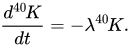
The radioactive decay of carbon-14 follows an exponential decay. A quantity is said to be subject to exponential decay if it decreases at a rate proportional to its value. Symbolically, this can be expressed as the following differential equation, where N is the quantity and λ is a positive number called the decay constant:

The solution to this equation is:
- ,

where is the initial value of .


For the particular case of radiocarbon decay, this equation is written:
- ,
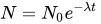
where, for a given sample of carbonaceous matter:
- = number of radiocarbon atoms at , i.e. the origin of the disintegration time,
- = number of radiocarbon atoms remaining after radioactive decay during the time ,
- radiocarbon decay or disintegration constant.
- Two related times can be defined:
- half-life: time lapsed for half the number of radiocarbon atoms in a given sample, to decay,
- mean- or average-life: mean or average time each radiocarbon atom spends in a given sample until it decays.


It can be shown that:
- = = radiocarbon half-life = 5568 years (Libby value)


- = = radiocarbon mean- or average-life = 8033 years (Libby value)


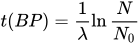
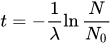
Notice that dates are customarily given in years BP which implies t(BP) = -t because the time arrow for dates runs in reverse direction from the time arrow for the corresponding ages. From these considerations and the above equation, it results:
For a raw radiocarbon date:
and for a raw radiocarbon age:
Content Disclaimer
Informasi ini disarikan dari Wikipedia dan disajikan kembali untuk tujuan edukasi. Konten tersedia di bawah lisensi CC BY-SA 3.0. Kami tidak bertanggung jawab atas ketidakakuratan data yang bersumber dari kontribusi publik tersebut.
- The information displayed on this website is sourced in part or in whole from Wikipedia and has been adapted for the purpose of restating it. We strive to provide accurate and relevant information, however:
- There is no guarantee of absolute accuracy. Wikipedia is an open, collaborative project that can be edited by anyone, so information is subject to change.
- It is not intended to constitute professional advice. The content displayed is for informational and educational purposes only. For important decisions (e.g., medical, legal, or financial), please consult a professional.
- Content copyright. Wikipedia is licensed under the Creative Commons Attribution-ShareAlike License (CC BY-SA). This means that content may be reused with appropriate attribution and shared under a similar license.
- Responsible use. Any risk arising from the use of information from this website is entirely the responsibility of the user.