Jeremy E. Riley, an electrical engineer, alumnus of the University of Utah. Love to contribute to science and math. Hoping to someday be a college professor and write books.
My Proof of one of L'Hôpital's Rules
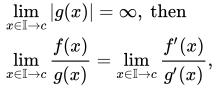
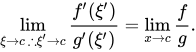
Given two differentiable functions f & g of x, with g'(x)≠0 and g(x)≠0, in a finite or infinite open interval , with c (an extended real number) at one extremity, and
provided the limit on the right exists.
In the below proofs, I use the shorthands
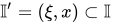
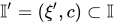
Also, I use the notation to mean any open interval with endpoints & , with nearer to ; i.e.,
and implies a one-sided approach from within.
Proof 1
In this proof, all variables and functions may take on the values of the extended real number system. A limit is considered to "exist" when it has a definite value, including one of -∞ or +∞, but not a range of values.
provided that f & g do not blow up in the open interval , i.e. f(ξ) & g(ξ) are finite, for all choices of , which is true because their individual differentiabilities guarantee their continuities in that interval.
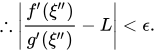
Let L be the second limit (given to exist), assumed finite. Due to the continuity of f' & g' , plus the fact that g'≠0, is continuous in . Defining , the existence of the limit is expressed as follows:
2
Given the continuity of f & g in , hence f and g being finite, and the monotone-increasing |g| in as x→c (because it is given that g'≠0 and g≠0), and defining , then is closer to c than is some ξ, itself chosen to be closer to c than ξ' to make |g| large enough to satisfy the following:
3
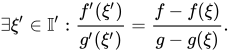
Now, given the differentiabilities of f & g and that g'≠0, everywhere in , and, from (3), that g(ξ' )≠g for , we may apply Cauchy's MVT to the finite interval :
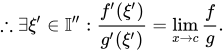
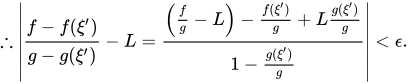
Multiplying both sides by the absolute value of the denominator and using (3) (since ), repeatedly, together with the triangle inequality rule,
This proves the theorem for finite limits, including zero. The case where the limit is ∞ can be reduced to one that is 0, by swopping the roles of the functions f & g, and the proof is complete.
Content Disclaimer
Informasi ini disarikan dari Wikipedia dan disajikan kembali untuk tujuan edukasi. Konten tersedia di bawah lisensi CC BY-SA 3.0. Kami tidak bertanggung jawab atas ketidakakuratan data yang bersumber dari kontribusi publik tersebut.
The information displayed on this website is sourced in part or in whole from Wikipedia and has been adapted for the purpose of restating it. We strive to provide accurate and relevant information, however:
There is no guarantee of absolute accuracy. Wikipedia is an open, collaborative project that can be edited by anyone, so information is subject to change.
It is not intended to constitute professional advice. The content displayed is for informational and educational purposes only. For important decisions (e.g., medical, legal, or financial), please consult a professional.
Content copyright. Wikipedia is licensed under the Creative Commons Attribution-ShareAlike License (CC BY-SA). This means that content may be reused with appropriate attribution and shared under a similar license.
Responsible use. Any risk arising from the use of information from this website is entirely the responsibility of the user.