Zassenhaus algorithm
In mathematics, the Zassenhaus algorithm[1] is a method to calculate a basis for the intersection and sum of two subspaces of a vector space. It is named after Hans Zassenhaus, but no publication of this algorithm by him is known.[2] It is used in computer algebra systems.[3]
Algorithm
Input
Let V be a vector space and U, W two finite-dimensional subspaces of V with the following spanning sets:

and

Finally, let be linearly independent vectors so that and can be written as


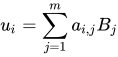
and
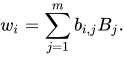
Output
The algorithm computes the base of the sum and a base of the intersection .


Algorithm
The algorithm creates the following block matrix of size :

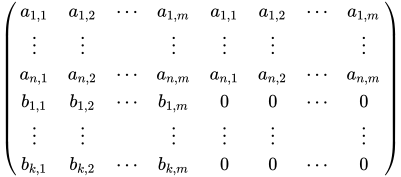
Using elementary row operations, this matrix is transformed to the row echelon form. Then, it has the following shape:
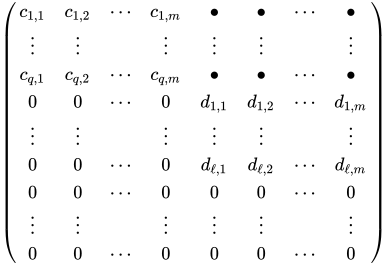
Here, stands for arbitrary numbers, and the vectors for every and for every are nonzero.


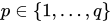
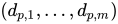
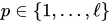
Then with

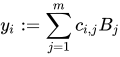
is a basis of and with

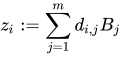
is a basis of .
Proof of correctness
First, we define to be the projection to the first component.

Let Then and .



Also, is the kernel of , the projection restricted to H. Therefore, .



The Zassenhaus algorithm calculates a basis of H. In the first m columns of this matrix, there is a basis of .

The rows of the form (with ) are obviously in . Because the matrix is in row echelon form, they are also linearly independent. All rows which are different from zero ( and ) are a basis of H, so there are such s. Therefore, the s form a basis of .


Example
Consider the two subspaces and of the vector space .
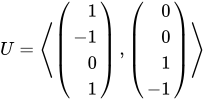
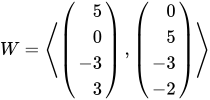

Using the standard basis, we create the following matrix of dimension :

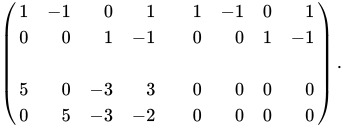
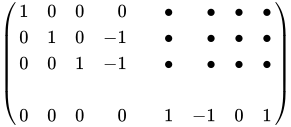
Using elementary row operations, we transform this matrix into the following matrix:
- (Some entries have been replaced by "" because they are irrelevant to the result.)
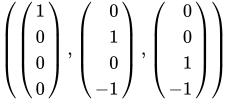
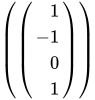
Therefore is a basis of , and is a basis of .
See also
References
- ^ Luks, Eugene M.; Rákóczi, Ferenc; Wright, Charles R. B. (April 1997), "Some algorithms for nilpotent permutation groups", Journal of Symbolic Computation, 23 (4): 335–354, doi:10.1006/jsco.1996.0092.
- ^ Fischer, Gerd (2012), Lernbuch Lineare Algebra und Analytische Geometrie (in German), Vieweg+Teubner, pp. 207–210, doi:10.1007/978-3-8348-2379-3, ISBN 978-3-8348-2378-6
- ^ The GAP Group (February 13, 2015), "24 Matrices", GAP Reference Manual, Release 4.7, retrieved 2015-06-11
External links
- "Mathematik-Online-Lexikon: Zassenhaus-Algorithmus" (in German). Retrieved 2012-09-15.
Content Disclaimer
Informasi ini disarikan dari Wikipedia dan disajikan kembali untuk tujuan edukasi. Konten tersedia di bawah lisensi CC BY-SA 3.0. Kami tidak bertanggung jawab atas ketidakakuratan data yang bersumber dari kontribusi publik tersebut.
- The information displayed on this website is sourced in part or in whole from Wikipedia and has been adapted for the purpose of restating it. We strive to provide accurate and relevant information, however:
- There is no guarantee of absolute accuracy. Wikipedia is an open, collaborative project that can be edited by anyone, so information is subject to change.
- It is not intended to constitute professional advice. The content displayed is for informational and educational purposes only. For important decisions (e.g., medical, legal, or financial), please consult a professional.
- Content copyright. Wikipedia is licensed under the Creative Commons Attribution-ShareAlike License (CC BY-SA). This means that content may be reused with appropriate attribution and shared under a similar license.
- Responsible use. Any risk arising from the use of information from this website is entirely the responsibility of the user.