RANDU

RANDU[1]는 선형 합동 생성기를 사용한 유사난수 생성기 루틴으로, 1960년대에 IBM 메인프레임에서 널리 사용된 이후 다른 시스템에서도 널리 사용되었다. 이 루틴이 사용하는 유사난수 생성기는 다음과 같이 정의되었다.
- , 단 은 홀수


RANDU는 역사상 최악으로 설계된 유사난수 생성기 중 하나로 알려져 있다. 조지 마서글리아는 1968년에 선형 합동 생성기로 만들어진 난수들로 이루어진 좌표를 3차원 공간 상에 표시하였을 때 유한한 수의 2차원 평면 중 하나 위에 위치하게 된다는 점(마서글리아 효과)을 밝혔는데, 그의 논문에 따르면 나눔수가 인 생성기의 최대 평면 수는 1290개지만 RANDU는 15개의 평면 상에 모든 점들이 위치하게 된다.

상관 관계의 설명
RANDU의 곱함수는 컴퓨터 상에서 비트 연산을 사용하여 빠르게 생성할 수 있도록 정해진 것이다. 실제로 C 언어로 RANDU는 곱셈 및 나눗셈 없이 다음과 같이 구현할 수 있다.
#include <stdint.h>

uint32_t randu(uint32_t previous)
{
    return (previous + (previous << 1) + (previous << 16)) & 0x7fffffff;
}
하지만 이러한 특성은 난수의 품질에 결정적으로 영향을 미친다. 이를 알아 보기 위해서 이 알려져 있을 때 그 다음 두 난수를 생성하면,

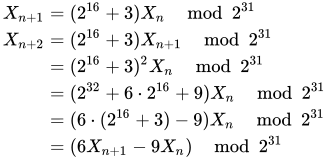
따라서 연속된 세 난수가 매우 강한 선형 상관 관계를 가지고 있음을 알 수 있다. (이 과정을 이해하기 위해서는 합동 산술을 참고하라.) 대부분의 ‘좋은’ 선형 합동 생성기는 이보다 훨씬 큰 계수를 가진 선형 상관 관계를 이루기 때문에 비교적 큰 문제를 보이지 않는다.
영향
RANDU는 1970년대 초반까지 몬테 카를로 시뮬레이션에 자주 사용되었으나, 다른 선형 합동 생성기보다도 못한 난수의 품질 때문에 당시 RANDU를 사용한 많은 실험 결과의 정확성에 큰 의문점을 안겨 주었다. 《Numerical Recipes》 시리즈에서 저자들은 다음과 같은 사례를 소개한 바 있다.
- 우리 중 한 사람은 단지 11개의 평면으로 이루어진 ‘무작위적인’ 그래프를 만든 뒤 그가 있던 컴퓨터 센터의 프로그래밍 컨설턴트가 난수 생성기를 잘못 사용했다고 말했던 일을 회고했다. “우리는 각 난수가 독립적으로 무작위적이라는 걸 보장하지, 둘 이상의 난수들이 무작위적이라는 건 보장하지 않습니다.”
참고 문헌
- Donald E. Knuth, The Art of Computer Programming, Volume 2, 3rd edition (Addison-Wesley, Boston, 1998).
- Marsaglia, George (1968), "Random Numbers Fall Mainly in the Planes," Proc National Academy of Sciences 61, 25-28.
- Press, William H., et al. (1992). Numerical Recipes in Fortran 77: The Art of Scientific Computing, 2nd edition. ISBN 0-521-43064-X.
- ↑ Compaq Fortran Language Reference Manual (Order Number: AA-Q66SD-TK) September 1999 (formerly DIGITAL Fortran and DEC Fortran 90)
Content Disclaimer
Informasi ini disarikan dari Wikipedia dan disajikan kembali untuk tujuan edukasi. Konten tersedia di bawah lisensi CC BY-SA 3.0. Kami tidak bertanggung jawab atas ketidakakuratan data yang bersumber dari kontribusi publik tersebut.
- The information displayed on this website is sourced in part or in whole from Wikipedia and has been adapted for the purpose of restating it. We strive to provide accurate and relevant information, however:
- There is no guarantee of absolute accuracy. Wikipedia is an open, collaborative project that can be edited by anyone, so information is subject to change.
- It is not intended to constitute professional advice. The content displayed is for informational and educational purposes only. For important decisions (e.g., medical, legal, or financial), please consult a professional.
- Content copyright. Wikipedia is licensed under the Creative Commons Attribution-ShareAlike License (CC BY-SA). This means that content may be reused with appropriate attribution and shared under a similar license.
- Responsible use. Any risk arising from the use of information from this website is entirely the responsibility of the user.