DFFITS
In statistics, DFFIT and DFFITS ("difference in fit(s)") are diagnostics meant to show how influential a point is in a linear regression, first proposed in 1980.[1]
DFFIT is the change in the predicted value for a point, obtained when that point is left out of the regression:

where and are the prediction for point i with and without point i included in the regression.


DFFITS is the Studentized DFFIT, where Studentization is achieved by dividing by the estimated standard deviation of the fit at that point:
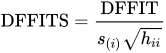
where is the standard error estimated without the point in question, and is the leverage for the point.


DFFITS also equals the products of the externally Studentized residual () and the leverage factor ():[2]

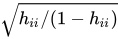
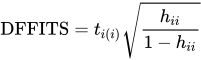
Thus, for low leverage points, DFFITS is expected to be small, whereas, as the leverage goes to 1, the distribution of the DFFITS value widens infinitely.
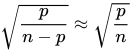
For a perfectly balanced experimental design (such as a factorial design or balanced partial factorial design), the leverage for each point is p/n, the number of parameters divided by the number of points. This means that the DFFITS values will be distributed (in the Gaussian case) as times a t variate. Therefore, the authors suggest investigating those points with DFFITS greater than .

Although the raw values resulting from the equations are different, Cook's distance and DFFITS are conceptually identical and there is a closed-form formula to convert one value to the other.[3]
Development
Previously when assessing a dataset before running a linear regression, the possibility of outliers would be assessed using histograms and scatterplots. Both methods of assessing data points were subjective and there was little way of knowing how much leverage each potential outlier had on the results data. This led to a variety of quantitative measures, including DFFIT, DFBETA.
References
- ^ Belsley, David A.; Kuh, Edwin; Welsh, Roy E. (1980). Regression Diagnostics: Identifying Influential Data and Sources of Collinearity. Wiley Series in Probability and Mathematical Statistics. New York: John Wiley & Sons. pp. 11–16. ISBN 0-471-05856-4.
- ^ Montgomery, Douglas C.; Peck, Elizabeth A.; Vining, G. Geoffrey (2012). Introduction to Linear Regression Analysis (5th ed.). Wiley. p. 218. ISBN 978-0-470-54281-1. Retrieved 22 February 2013.
Thus, DFFITSi is the value of R-student multiplied by the leverage of the ith observation [hii/(1 − hii)]1/2.
- ^ Cohen, Jacob; Cohen, Patricia; West, Stephen G.; Aiken, Leona S. (2003). Applied Multiple Regression/Correlation Analysis for the Behavioral Sciences. ISBN 0-8058-2223-2.
Content Disclaimer
Informasi ini disarikan dari Wikipedia dan disajikan kembali untuk tujuan edukasi. Konten tersedia di bawah lisensi CC BY-SA 3.0. Kami tidak bertanggung jawab atas ketidakakuratan data yang bersumber dari kontribusi publik tersebut.
- The information displayed on this website is sourced in part or in whole from Wikipedia and has been adapted for the purpose of restating it. We strive to provide accurate and relevant information, however:
- There is no guarantee of absolute accuracy. Wikipedia is an open, collaborative project that can be edited by anyone, so information is subject to change.
- It is not intended to constitute professional advice. The content displayed is for informational and educational purposes only. For important decisions (e.g., medical, legal, or financial), please consult a professional.
- Content copyright. Wikipedia is licensed under the Creative Commons Attribution-ShareAlike License (CC BY-SA). This means that content may be reused with appropriate attribution and shared under a similar license.
- Responsible use. Any risk arising from the use of information from this website is entirely the responsibility of the user.