Shanks's square forms factorization
 | This article includes a list of general references but lacks sufficient corresponding inline citations. (March 2015) |
Shanks' square forms factorization is a method for integer factorization devised by Daniel Shanks as an improvement on Fermat's factorization method.
The success of Fermat's method depends on finding integers and such that , where is the integer to be factored. An improvement (noticed by Kraitchik) is to look for integers and such that . Finding a suitable pair does not guarantee a factorization of , but it implies that is a factor of , and there is a good chance that the prime divisors of are distributed between these two factors, so that calculation of the greatest common divisor of and will give a non-trivial factor of .


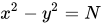





A practical algorithm for finding pairs which satisfy was developed by Shanks, who named it Square Forms Factorization or SQUFOF. The algorithm can be expressed in terms of continued fractions or in terms of quadratic forms. Although there are now much more efficient factorization methods available, SQUFOF has the advantage that it is small enough to be implemented on a programmable calculator. Shanks programmed it on an HP-65, made in 1974, which has storage for only nine digit numbers and allows only 100 steps/keystrokes of programming. There are versions of the algorithm that use little memory and versions that store a list of values that run more quickly.
In 1858, the Czech mathematician Václav Šimerka used a method similar to SQUFOF to factor .[1]




Algorithm
Note This version of the algorithm works on some examples but often gets stuck in a loop.
This version does not use a list.
Input: , the integer to be factored, which must be neither a prime number nor a perfect square, and a small positive integer, .

Output: a non-trivial factor of .
The algorithm:
- (Phase 1, forward cycle.) Initialize
- Repeat
until is a perfect square at some odd value of . - (Phase 2, reverse cycle.) Initialize where , and are from the previous phase. (The variables correspond to the from the first loop.)
- Repeat
until [citation needed]
Then if is not equal to and not equal to , then is a non-trivial factor of . Otherwise try another value of .
[citation needed]


Shanks' method has time complexity .[2]
![{\displaystyle O({\sqrt[{4}]{N}})}](https://wikimedia.org/api/rest_v1/media/math/render/svg/9406569abb16b2edbf156718c0392450a6a65215)
Stephen S. McMath wrote a more detailed discussion of the mathematics of Shanks' method, together with a proof of its correctness.[3]
Example
Let


| Cycle forward | |||
|---|---|---|---|


Here is a perfect square, so the first phase ends.

For the second phase, set . Then:

| Reverse cycle | |||
|---|---|---|---|


Here , so the second phase ends. Now calculate , which is a factor of .



Thus, .

Example implementation
Below is an example of C function for performing SQUFOF factorization on unsigned integer not larger than 64 bits, without overflow of the transient operations. [citation needed]
#include <inttypes.h>
#define nelems(x) (sizeof(x) / sizeof((x)[0]))

const int multiplier[] = {1, 3, 5, 7, 11, 3*5, 3*7, 3*11, 5*7, 5*11, 7*11, 3*5*7, 3*5*11, 3*7*11, 5*7*11, 3*5*7*11};

uint64_t SQUFOF( uint64_t N )
{
    uint64_t D, Po, P, Pprev, Q, Qprev, q, b, r, s;
    uint32_t L, B, i;
    s = (uint64_t)(sqrtl(N)+0.5);
    if (s*s == N) return s;
    for (int k = 0; k < nelems(multiplier) && N <= UINT64_MAX/multiplier[k]; k++) {
        D = multiplier[k]*N;
        Po = Pprev = P = sqrtl(D);
        Qprev = 1;
        Q = D - Po*Po;
        L = 2 * sqrtl( 2*s );
        B = 3 * L;
        for (i = 2 ; i < B ; i++) {
            b = (uint64_t)((Po + P)/Q);
            P = b*Q - P;
            q = Q;
            Q = Qprev + b*(Pprev - P);
            r = (uint64_t)(sqrtl(Q)+0.5);
            if (!(i & 1) && r*r == Q) break;
            Qprev = q;
            Pprev = P;
        };
        if (i >= B) continue;
        b = (uint64_t)((Po - P)/r);
        Pprev = P = b*r + P;
        Qprev = r;
        Q = (D - Pprev*Pprev)/Qprev;
        i = 0;
        do {
            b = (uint64_t)((Po + P)/Q);
            Pprev = P;
            P = b*Q - P;
            q = Q;
            Q = Qprev + b*(Pprev - P);
            Qprev = q;
            i++;
        } while (P != Pprev);
        r = gcd(N, Qprev);
        if (r != 1 && r != N) return r;
    }
    return 0;
}
References
- ^ Lemmermeyer, F. (2013). "Václav Šimerka: quadratic forms and factorization". LMS Journal of Computation and Mathematics. 16: 118–129. doi:10.1112/S1461157013000065.
- ^ (Riesel 1994:189)
- ^ "Daniel Shanks' Square Forms Factorization". 2004. CiteSeerX 10.1.1.107.9984.
{{cite CiteSeerX}}: Cite uses deprecated parameter|citeseerx=(help)
- D. A. Buell (1989). Binary Quadratic Forms. Springer-Verlag. ISBN 0-387-97037-1.
- D. M. Bressoud (1989). Factorisation and Primality Testing. Springer-Verlag. ISBN 0-387-97040-1.
- Riesel, Hans (1994). Prime Numbers and Computer Methods for Factorization (2nd ed.). Birkhauser. ISBN 0-8176-3743-5.
- Gower, Jason E. (December 2004). Square form factorization (PDF) (PhD thesis). Purdue University. CERIAS Tech Report 2004-31. A very detailed analysis of SQUFOF
- Gower, Jason E.; Wagstaff, Samuel S. Jr. (January 2008). "Square Form Factorization" (PDF). Mathematics of Computation. 77 (261): 551–588. Bibcode:2008MaCom..77..551G. doi:10.1090/S0025-5718-07-02010-8. A summary of the preceding thesis, also very detailed.
- Samuel S. Wagstaff, Jr. (2013). The Joy of Factoring. Providence, RI: American Mathematical Society. pp. 163–168. ISBN 978-1-4704-1048-3.
External links
- Daniel Shanks: Analysis and Improvement of the Continued Fraction Method of Factorization, (transcribed by S. McMath 2004)
- Daniel Shanks: SQUFOF Notes, (transcribed by S. McMath 2004)
- Stephen S. McMath: Parallel integer factorization using quadratic forms, 2005
- S. McMath, F. Crabbe, D. Joyner: Continued fractions and parallel SQUFOF, 2005
- Jason Gower, Samuel Wagstaff: Square Form Factorisation (Published)
- Shanks's SQUFOF Factoring Algorithm
- java-math-library
Content Disclaimer
Informasi ini disarikan dari Wikipedia dan disajikan kembali untuk tujuan edukasi. Konten tersedia di bawah lisensi CC BY-SA 3.0. Kami tidak bertanggung jawab atas ketidakakuratan data yang bersumber dari kontribusi publik tersebut.
- The information displayed on this website is sourced in part or in whole from Wikipedia and has been adapted for the purpose of restating it. We strive to provide accurate and relevant information, however:
- There is no guarantee of absolute accuracy. Wikipedia is an open, collaborative project that can be edited by anyone, so information is subject to change.
- It is not intended to constitute professional advice. The content displayed is for informational and educational purposes only. For important decisions (e.g., medical, legal, or financial), please consult a professional.
- Content copyright. Wikipedia is licensed under the Creative Commons Attribution-ShareAlike License (CC BY-SA). This means that content may be reused with appropriate attribution and shared under a similar license.
- Responsible use. Any risk arising from the use of information from this website is entirely the responsibility of the user.