Spectral centroid
The spectral centroid is a measure used in digital signal processing to characterise a spectrum. It indicates where the center of mass of the spectrum is located. Perceptually, it has a robust connection with the impression of brightness of a sound.[1] It is sometimes called center of spectral mass.[2]
Calculation
It is calculated as the weighted mean of the frequencies present in the signal, determined using a Fourier transform, with their magnitudes as the weights:[3]
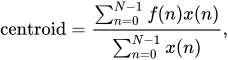
where x(n) represents the weighted frequency value, or magnitude, of bin number n, and f(n) represents the center frequency of that bin.
Alternative usage
Some people use "spectral centroid" to refer to the median of the spectrum. This is a different statistic, the difference being essentially the same as the difference between the unweighted median and mean statistics. Since both are measures of central tendency, in some situations they will exhibit some similarity of behaviour. But since typical audio spectra are not normally distributed, the two measures will often give strongly different values. Grey and Gordon in 1978 found the mean a better fit than the median.[1]
Applications
Because the spectral centroid is a good predictor of the "brightness" of a sound,[1] it is widely used in digital audio and music processing as an automatic measure of musical timbre.[4]
References
- ^ a b c Grey, John M.; Gordon, John W. (1978). "Perceptual effects of spectral modifications on musical timbres". The Journal of the Acoustical Society of America. 63 (5). Acoustical Society of America (ASA): 1493–1500. Bibcode:1978ASAJ...63.1493G. doi:10.1121/1.381843. ISSN 0001-4966.
- ^ Pulavarti, Surya V. S. R. K.; Maguire, Jack B.; Yuen, Shirley; Harrison, Joseph S.; Griffin, Jermel; Premkumar, Lakshmanane; Esposito, Edward A.; Makhatadze, George I.; Garcia, Angel E.; Weiss, Thomas M.; Snell, Edward H. (2022-02-17). "From Protein Design to the Energy Landscape of a Cold Unfolding Protein". The Journal of Physical Chemistry B. 126 (6): 1212–1231. doi:10.1021/acs.jpcb.1c10750. ISSN 1520-6106. PMC 9281400. PMID 35128921.
- ^ A Large Set of Audio Features for Sound Description. Technical report published by IRCAM in 2003. Section 6.1.1 describes the spectral centroid.
- ^ Schubert, Emery; Wolfe, Joe; Tarnopolsky, Alex (2004). "Spectral centroid and timbre in complex, multiple instrumental textures" (PDF). Proceedings of the 8th International Conference on Music Perception & Cognition, North Western University, Illinois. International Conference on Music Perception & Cognition. Lipscomb, S.D.; Ashley, R.; Gjerdingen, R. O.; Webster, P. (Eds.). Sydney, Australia: School of Music and Music Education; School of Physics, University of New South Wales. Archived from the original (PDF) on 2011-08-10.
Content Disclaimer
Informasi ini disarikan dari Wikipedia dan disajikan kembali untuk tujuan edukasi. Konten tersedia di bawah lisensi CC BY-SA 3.0. Kami tidak bertanggung jawab atas ketidakakuratan data yang bersumber dari kontribusi publik tersebut.
- The information displayed on this website is sourced in part or in whole from Wikipedia and has been adapted for the purpose of restating it. We strive to provide accurate and relevant information, however:
- There is no guarantee of absolute accuracy. Wikipedia is an open, collaborative project that can be edited by anyone, so information is subject to change.
- It is not intended to constitute professional advice. The content displayed is for informational and educational purposes only. For important decisions (e.g., medical, legal, or financial), please consult a professional.
- Content copyright. Wikipedia is licensed under the Creative Commons Attribution-ShareAlike License (CC BY-SA). This means that content may be reused with appropriate attribution and shared under a similar license.
- Responsible use. Any risk arising from the use of information from this website is entirely the responsibility of the user.