Hidden linear function problem
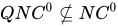
The hidden linear function problem, is a search problem that generalizes the Bernstein–Vazirani problem.[1] In the Bernstein–Vazirani problem, the hidden function is implicitly specified in an oracle; while in the 2D hidden linear function problem (2D HLF), the hidden function is explicitly specified by a matrix and a binary vector. 2D HLF can be solved exactly by a constant-depth quantum circuit restricted to a 2-dimensional grid of qubits using bounded fan-in gates but can't be solved by any sub-exponential size, constant-depth classical circuit using unbounded fan-in biased threshold gates.[2][3] While Bernstein–Vazirani's problem was designed to prove an oracle separation between complexity classes BQP and BPP, 2D HLF was designed to prove an explicit separation between the circuit classes and ().[1]


2D HLF problem statement
Given (an upper- triangular binary matrix of size ) and (a binary vector of length ),


define a function :


and

There exists a such that


Find .[1]

2D HLF algorithm
With 3 registers; the first holding , the second containing and the third carrying an -qubit state, the circuit has controlled gates which implement from the first two registers to the third.


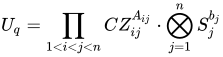
This problem can be solved by a quantum circuit, , where H is the Hadamard gate, S is the S gate and CZ is CZ gate. It is solved by this circuit because with , iff is a solution.[1]



References
- ^ a b c d Bravyi, Sergey; Gosset, David; Robert, König (2018-10-19). "Quantum advantage with shallow circuits". Science. 362 (6412): 308–311. arXiv:1704.00690. Bibcode:2018Sci...362..308B. doi:10.1126/science.aar3106. PMID 30337404. S2CID 16308940.
- ^ Watts, Adam Bene; Kothari, Robin; Schaeffer, Luke; Tal, Avishay (2019-06-23). "Exponential separation between shallow quantum circuits and unbounded fan-in shallow classical circuits". ACM: 515–526. arXiv:1906.08890. doi:10.1145/3313276.3316404. ISBN 978-1-4503-6705-9.
{{cite journal}}: Cite journal requires|journal=(help)CS1 maint: periodical has ISBN (link) - ^ de Oliveira, Michael; Subramanian, Sathyawageeswar; Mendes, Leandro; Hsieh, Min-Hsiu (2025-04-15). "Unconditional advantage of noisy qudit quantum circuits over biased threshold circuits in constant depth". Nature Communications. 16 (1): 3559. doi:10.1038/s41467-025-58545-4. ISSN 2041-1723. PMC 12000609. PMID 40234377.
External links
| General | |||||||||
|---|---|---|---|---|---|---|---|---|---|
| Theorems | |||||||||
| Quantum communication |
| ||||||||
| Quantum algorithms | |||||||||
| Quantum complexity theory | |||||||||
| Quantum processor benchmarks | |||||||||
| Quantum computing models | |||||||||
| Quantum error correction | |||||||||
| Physical implementations |
| ||||||||
| Quantum programming | |||||||||


Content Disclaimer
Informasi ini disarikan dari Wikipedia dan disajikan kembali untuk tujuan edukasi. Konten tersedia di bawah lisensi CC BY-SA 3.0. Kami tidak bertanggung jawab atas ketidakakuratan data yang bersumber dari kontribusi publik tersebut.
- The information displayed on this website is sourced in part or in whole from Wikipedia and has been adapted for the purpose of restating it. We strive to provide accurate and relevant information, however:
- There is no guarantee of absolute accuracy. Wikipedia is an open, collaborative project that can be edited by anyone, so information is subject to change.
- It is not intended to constitute professional advice. The content displayed is for informational and educational purposes only. For important decisions (e.g., medical, legal, or financial), please consult a professional.
- Content copyright. Wikipedia is licensed under the Creative Commons Attribution-ShareAlike License (CC BY-SA). This means that content may be reused with appropriate attribution and shared under a similar license.
- Responsible use. Any risk arising from the use of information from this website is entirely the responsibility of the user.