Radonifying operator
 | This article relies on a single source. (March 2026) |
In measure theory, a radonifying operator (ultimately named after Johann Radon) between measurable spaces is one that takes a cylinder set measure (CSM) on the first space to a true measure on the second space. It acquired its name because the pushforward measure on the second space was historically thought of as a Radon measure.
Definition
Given two separable Banach spaces and , a CSM on and a continuous linear map , we say that is radonifying if the push forward CSM (see below) on "is" a measure, i.e. there is a measure on such that



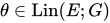




for each , where is the usual push forward of the measure by the linear map .[1]


Push forward of a CSM
Because the definition of a CSM on requires that the maps in be surjective, the definition of the push forward for a CSM requires careful attention. The CSM

is defined by

if the composition is surjective. If is not surjective, let be the image of , let be the inclusion map, and define



- ,

where (so ) is such that .



See also
- Abstract Wiener space – Mathematical construction relating to infinite-dimensional spaces
- Classical Wiener space – Space of stochastic processes
- Sazonov's theorem
References
- ^ van Neerven, Jan. "-randonifying Operators - A Survey" (PDF). Australian National University. Retrieved 8 Mar 2026.

| Spaces |
| ||||
|---|---|---|---|---|---|
| Theorems | |||||
| Operators | |||||
| Algebras | |||||
| Open problems | |||||
| Applications | |||||
| Advanced topics | |||||

Content Disclaimer
Informasi ini disarikan dari Wikipedia dan disajikan kembali untuk tujuan edukasi. Konten tersedia di bawah lisensi CC BY-SA 3.0. Kami tidak bertanggung jawab atas ketidakakuratan data yang bersumber dari kontribusi publik tersebut.
- The information displayed on this website is sourced in part or in whole from Wikipedia and has been adapted for the purpose of restating it. We strive to provide accurate and relevant information, however:
- There is no guarantee of absolute accuracy. Wikipedia is an open, collaborative project that can be edited by anyone, so information is subject to change.
- It is not intended to constitute professional advice. The content displayed is for informational and educational purposes only. For important decisions (e.g., medical, legal, or financial), please consult a professional.
- Content copyright. Wikipedia is licensed under the Creative Commons Attribution-ShareAlike License (CC BY-SA). This means that content may be reused with appropriate attribution and shared under a similar license.
- Responsible use. Any risk arising from the use of information from this website is entirely the responsibility of the user.